What Happens to Your Body When You Sleep Less Than 6 Hours Every Night? (2026 Guide)
By Ankush Kumar — Coach, International Sport Science Association | QuadFit
I used to be proud of sleeping less.
There was a phase in my life — early in my coaching career, building things from scratch — where I treated five hours of sleep like a badge of honour. Up at 5, in bed by midnight, grinding through the day on chai and adrenaline. I thought I was being productive. I thought the people sleeping eight hours were wasting time.
What I didn't realise was that I was slowly making myself worse at everything. Memory, mood, decision-making, physical recovery — all of it was degrading in ways I couldn't fully see because the degradation itself was affecting my ability to assess myself clearly.
That's the cruel irony of chronic sleep deprivation. It makes you worse at recognising how much worse you've become.
I eventually got a full blood panel done as part of a health audit. Elevated fasting glucose, higher cortisol markers, suboptimal testosterone for my age. My doctor looked at my lifestyle and asked one question: "How much are you sleeping?"
Five hours, I said. Maybe six on a good night.
He just nodded slowly, like he'd heard this exact story before. Which he had. Many times.
That was the beginning of me taking sleep seriously — not as a luxury, but as a genuine biological requirement. And the more I've studied it since, the more I'm convinced that chronic sleep deprivation is one of the most underestimated health crises in modern life.

Six Hours Feels Fine. That's Exactly the Problem.
Most people who sleep six hours or less every night don't feel terrible. They feel... okay. Tired in that low-grade background way that becomes so familiar it stops registering as tiredness. They're functional. They get through the day. They probably drink a lot of chai or coffee and assume that's just normal.
This is what makes chronic sleep deprivation so dangerous — it doesn't hurt in any obvious way. It just slowly, quietly degrades almost every system in your body while you carry on assuming you're basically fine.
Research from the University of Pennsylvania put this into sharp relief. They took people sleeping six hours a night and tested their cognitive performance over two weeks. The subjects got progressively worse on every measure — reaction time, memory, problem solving. But here's the part that matters: when asked how they felt, they consistently reported feeling "slightly tired" — essentially fine. Their subjective sense of how they were doing completely failed to track the actual deterioration.
You cannot accurately judge how impaired you are by chronic sleep loss, because the impairment affects the judgment itself.
What's Happening in Your Brain
Sleep isn't downtime for your brain. It's arguably the most active and important thing your brain does.
During deep sleep, the brain runs what researchers have called a "glymphatic system" — essentially a waste clearance process where cerebrospinal fluid flushes out toxic proteins that accumulate during waking hours. One of the proteins cleared is beta-amyloid, the same substance that forms plaques in Alzheimer's disease.
When you cut sleep short, this cleaning cycle gets cut short too. The toxins accumulate faster than they're cleared. This isn't theoretical — studies have shown that even one night of sleep deprivation measurably increases beta-amyloid buildup in the brain. Do that repeatedly, for years, and the long-term implications become very concerning.
Short term, the effects on the brain are things most people have experienced but never connected to sleep. That feeling of walking into a room and forgetting why you came. Struggling to find words mid-sentence. Reading the same paragraph three times. Getting disproportionately irritated by small things. Making impulsive decisions you'd normally think twice about.
None of that feels like "brain damage" — but it is functional impairment, and it's directly caused by insufficient sleep.
The prefrontal cortex — the part of your brain responsible for rational thinking, impulse control, and emotional regulation — is particularly sensitive to sleep loss. This is why sleep-deprived people are more reactive, more emotional, less patient, and worse at planning. It's also why sleep-deprived people tend to reach for high-sugar, high-fat foods — the impulse control that would normally moderate those choices is partially offline.
What's Happening to Your Heart
The cardiovascular data on sleep deprivation is genuinely alarming and doesn't get talked about enough.
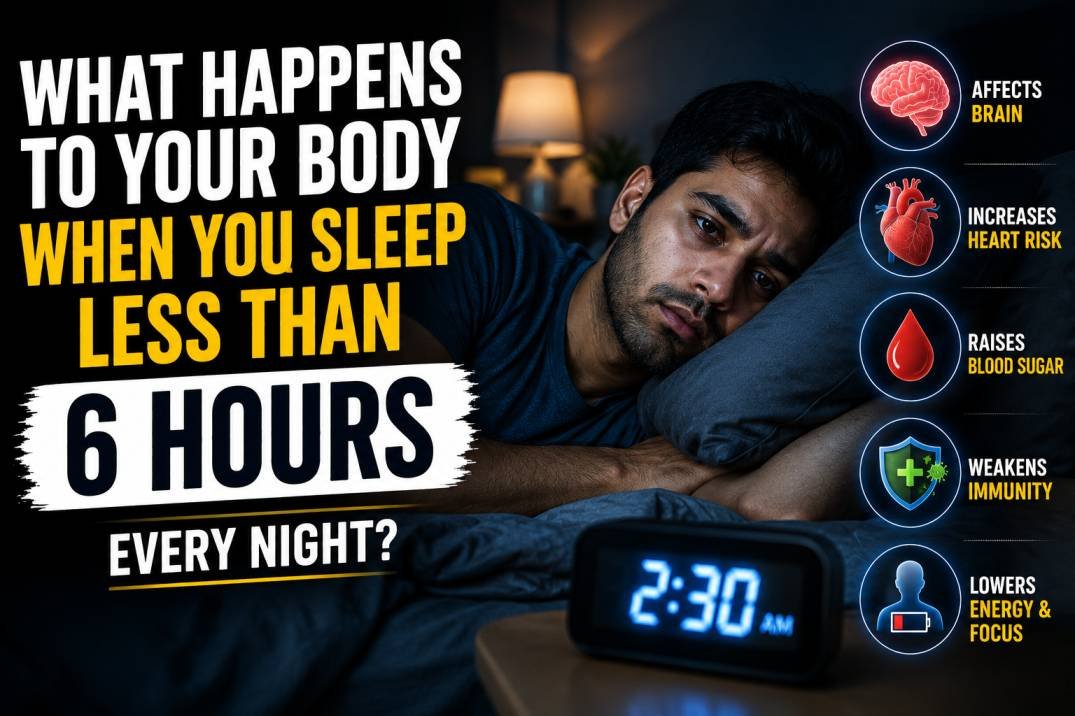
People who consistently sleep less than six hours have significantly higher rates of hypertension, heart attack, and stroke compared to those sleeping seven to eight hours. A large analysis of data from over 470,000 people across multiple countries found that short sleepers had a 48% higher risk of developing or dying from coronary heart disease.
The mechanisms are multiple. Sleep deprivation raises blood pressure — both immediately and chronically. It increases inflammatory markers in the blood that damage arterial walls over time. It elevates cortisol and adrenaline, hormones that in short bursts are fine but in chronic excess are hard on the cardiovascular system. It disrupts the normal nighttime dip in blood pressure that the heart relies on for recovery.
Your heart is supposed to get a break at night. Blood pressure naturally drops during deep sleep, giving the cardiovascular system a period of lower demand. Cut sleep short and that recovery window shrinks. Do it every night for years and the cumulative wear is significant.
This isn't about one bad night. Everyone has those. It's about the pattern — the chronic, habitual shortchanging of sleep that millions of people have normalised.
What's Happening to Your Metabolism and Blood Sugar
This is the connection I find most striking, and it's the one most directly relevant to the clients I work with.
Sleep deprivation impairs insulin sensitivity — sometimes dramatically and very quickly. Studies have shown that just one week of sleeping five to six hours can push a healthy person's glucose metabolism into a prediabetic pattern. The body becomes less effective at clearing glucose from the bloodstream, the pancreas has to work harder, and fasting blood sugar rises.
The hormonal picture explains why. Sleep loss raises cortisol, which raises blood sugar. It also disrupts the balance of two appetite-regulating hormones: ghrelin (which makes you hungry) goes up, and leptin (which makes you feel full) goes down. The result is that sleep-deprived people are genuinely hungrier, have stronger cravings for calorie-dense foods, and have weaker satiety signals telling them to stop eating.
This is not a willpower problem. It's a hormonal problem caused by insufficient sleep.
There's also a direct relationship between sleep and weight gain that goes beyond the hunger hormones. Sleep deprivation slows the rate at which the body burns fat for fuel. It promotes muscle breakdown. It creates a metabolic environment that actively resists fat loss — which is why I always tell clients who are trying to lose weight or manage blood sugar: if your sleep isn't sorted, the diet and exercise work is fighting uphill.
You cannot out-train or out-eat chronically bad sleep. I've seen this repeatedly. A client doing everything right — training consistently, eating well — but sleeping five hours a night because of work stress. Numbers barely move. Sleep improves. Numbers shift within weeks.
What's Happening to Your Immune System
Your immune system does a significant portion of its repair and maintenance work during sleep. Cytokines — proteins that help fight infection and inflammation — are produced and released primarily during sleep. Cut sleep short and you produce fewer of them.
The practical result is straightforward: sleep-deprived people get sick more often, stay sick longer, and respond less effectively to vaccines. A study from Carnegie Mellon University found that people sleeping less than seven hours were nearly three times more likely to develop a cold after being exposed to the virus than those sleeping eight hours or more.
Three times. Not a marginal difference.
Chronic sleep deprivation also creates a state of low-grade systemic inflammation — elevated C-reactive protein and other inflammatory markers — that underlies a huge range of chronic diseases. Inflammation is the common thread connecting sleep deprivation to heart disease, diabetes, depression, and even certain cancers.
What's Happening to Your Hormones
Beyond insulin and cortisol, sleep deprivation disrupts the hormonal system broadly in ways that affect mood, energy, body composition, and long-term health.
Growth hormone — which is essential for tissue repair, muscle building, and fat metabolism — is released primarily during deep sleep. Specifically during slow-wave sleep in the first half of the night. If you're cutting sleep short or sleeping poorly, you're getting less growth hormone. This matters for everyone, but especially for people who exercise regularly expecting recovery and adaptation — you can't fully recover from training without adequate deep sleep.
In men, chronic sleep deprivation has been linked to significantly lower testosterone levels. One study found that men sleeping five hours a night had testosterone levels equivalent to someone ten years older. Low testosterone affects energy, mood, libido, body composition, and motivation. Many men chasing these symptoms with supplements would be better served by simply sleeping more.
In women, the disruption to hormonal balance from poor sleep can worsen PMS symptoms, affect menstrual regularity, and compound the hormonal volatility of perimenopause. Sleep isn't just rest — it's hormonal regulation.
What's Happening to Your Mental Health
The relationship between sleep and mental health runs in both directions — poor sleep worsens mental health, and poor mental health disrupts sleep. But the sleep-first direction is underappreciated.
Sleep deprivation measurably increases anxiety and emotional reactivity. The amygdala — the brain's threat-detection centre — becomes 60% more reactive under sleep deprivation, according to research from UC Berkeley. The prefrontal cortex that normally keeps the amygdala in check is less active. The result is a brain that is more easily alarmed, less able to regulate that alarm, and more prone to seeing neutral situations as threatening.
This isn't a personality trait. It's a neurological state caused by insufficient sleep.
Depression and sleep deprivation share overlapping biology. Serotonin regulation, which is central to mood stability, is disrupted by poor sleep. The emotional processing that happens during REM sleep — which appears to help the brain metabolise difficult experiences — gets cut short when sleep is insufficient. People who are chronically under-slept are at meaningfully higher risk of developing clinical depression and anxiety disorders.
The Things People Try Instead of Sleeping
Let me be direct about a few common workarounds, because I see clients try all of these.
Caffeine — works by blocking adenosine receptors, which is the brain chemical that creates sleep pressure. It doesn't eliminate sleep need. It masks it temporarily, while adenosine continues accumulating. When the caffeine wears off, the crash is often worse. Caffeine also has a half-life of about five to six hours, meaning a 3 PM coffee still has half its caffeine in your system at 9 PM, actively disrupting sleep onset even if you don't feel it doing so.
Weekend catch-up sleep — popular idea, limited effectiveness. You can partially recover some cognitive function with a few nights of longer sleep, but the metabolic damage from the week — the glucose dysregulation, the immune suppression, the hormonal disruption — doesn't fully reverse with two days of catch-up. Sleep debt doesn't work like a bank account you can refill on weekends.
Naps — genuinely useful as a complement, not a replacement. A 20-minute nap can restore alertness meaningfully. But it doesn't replicate the deep sleep and REM cycles that nighttime sleep provides. A nap plus short nighttime sleep is still worse than adequate nighttime sleep.
What You Can Actually Do
I want to give practical answers here, not generic "practice good sleep hygiene" advice that nobody does anything with.
Find your actual bedtime and protect it. Most people know roughly what time they need to wake up. Count back eight hours. That's your target bedtime. Not an aspiration — a boundary. What happens in the hour before that bedtime matters enormously.
The phone is the single biggest lever. Blue light suppresses melatonin production for hours. Stimulating content — social media, news, heated conversations over text — activates the nervous system at exactly the moment it needs to be winding down. Moving the phone out of the bedroom is not a small thing. It's probably the highest-impact sleep intervention available to most people, and it costs nothing.
Temperature matters more than most people realise. Core body temperature needs to drop to initiate and maintain deep sleep. A room that's too warm is a consistent cause of light, fragmented sleep. Cooler is almost always better — somewhere around 18 to 20 degrees Celsius is where most people sleep best.
Don't eat a large meal within two hours of sleep. Digestion raises core body temperature and keeps the metabolic system active, both of which work against deep sleep. A light snack is fine. A full dinner at 10 PM before sleeping at 11 is not.
Consistency across the week is more important than total hours. Sleeping at wildly different times on weekdays versus weekends — "social jet lag" — disrupts circadian rhythm in a way that undermines sleep quality even when the hours are there. A consistent sleep-wake schedule, including weekends, is more valuable than most people give it credit for.
The Honest Bottom Line
Sleeping less than six hours every night is not a productivity strategy. It's not a sign of discipline or ambition. It's a slow, quiet form of self-damage that accumulates across the brain, heart, metabolism, immune system, hormones, and mental health — in ways that often aren't obvious until something goes noticeably wrong.
The frustrating part is that everything else you do for your health — the exercise, the diet, the stress management — works better when sleep is adequate, and works against itself when sleep is chronically short.
I spent years being smug about how little sleep I needed. I was wrong, and I have the blood work from that period to prove it. Sleep is not the thing you sacrifice to get more done. It's the foundation everything else is built on.
If you're consistently sleeping under six hours, that's the health intervention to start with. Not a new supplement, not a new workout program, not a new diet.
Sleep more. Everything else becomes easier when you do.
About the Author Ankush Kumar is a certified fitness and health coach with the International Sport Science Association (ISSA) and the founder of QuadFit, based in Raipur. He works with clients on metabolic health, body composition, and sustainable lifestyle change — with a focus on the real factors that determine long-term health outcomes, not just what happens in the gym.
This article is for informational and educational purposes only and does not constitute medical advice. If you are experiencing health symptoms or concerns related to sleep, please consult a qualified healthcare professional.