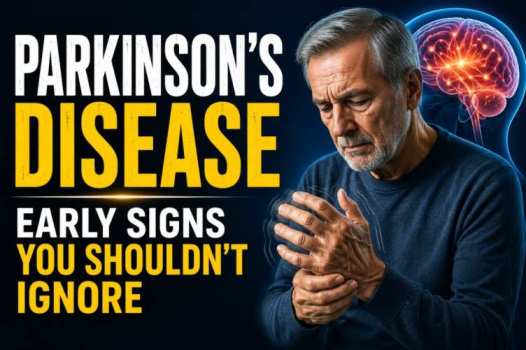
Parkinson's Disease: Early Signs, Causes, Symptoms and Treatment in 2026
My neighbour's father started dropping things. A cup. His keys. Small stuff that you'd normally chalk up to a bad day. His handwriting went tiny too — like he was cramming words into spaces that weren't there. The family thought he was just tired. Overworked. Then one evening his right hand started shaking while he was just sitting there watching TV. Not a lot. Just a little tremble. They figured it was age. What else would it be?
Two years went by before anyone said the word Parkinson's.
Two years.
That's not a rare thing either. That's basically the pattern. The early signs don't announce themselves. They're quiet and easy to explain away, and by the time a doctor finally puts a name to what's happening, the disease has usually been there for a long time already.
Most people know Parkinson's as "the shaking disease." That's about as far as it goes for most people. What gets left out is that some people with Parkinson's barely shake at all. That it can start in your 40s. That it's not purely a movement condition — it gets into sleep, mood, memory, digestion. It's a much bigger thing than the hand tremor image suggests.
This guide covers the whole thing. What Parkinson's is, what happens in the brain, the warning signs people miss, how it progresses, what causes it, how it gets diagnosed, and what treatment actually looks like in 2026.
What Is Parkinson's Disease
Parkinson's is a progressive brain condition. Progressive meaning it gets worse over time, not that it's trendy. It mainly disrupts movement but the effects spread a lot further than that.
The core problem is in a small brain region called the substantia nigra. That's where dopamine gets made. Dopamine is what helps the brain coordinate smooth, controlled movement. In Parkinson's, the cells there die off gradually. Dopamine falls. The brain's ability to control movement falls with it.
What makes this especially tricky is timing. By the time a person notices something is wrong — hand shaking, stiffness, slowness — somewhere between 60 to 80 percent of those dopamine-making cells are already gone. The disease had been running quietly for years. Maybe a decade or more.
Why does it happen? Nobody has a complete answer yet. It looks like a mix of genetics and environmental factors that interact over a long time, which is part of why it's been so hard to pin down a single cause.
What's Happening in the Brain
Dopamine isn't just a mood thing, though people mostly hear about it that way. For movement, it works as a signal between the substantia nigra and a part of the brain called the striatum, which coordinates how you move. When that signal is healthy, movement is automatic and smooth. When it's breaking down, everything becomes effortful. Slow. Stiff. Like wading through something thick.
There's also something happening at the cellular level worth knowing about. A protein called alpha-synuclein clumps together abnormally inside neurons. These clumps are called Lewy bodies. They don't just show up in the motor areas — they're also found in areas tied to smell, sleep, mood, and the body's automatic functions like digestion and blood pressure regulation. Which is exactly why Parkinson's produces so many symptoms that seem to have nothing to do with movement.
Researchers now think the disease likely starts in the gut and the smell system, then spreads upward toward the motor regions over years. That's why problems like constipation and a reduced sense of smell can appear a decade before any shaking or stiffness. The brain is already dealing with something. It just hasn't reached the parts that control movement yet.
Early Signs That Get Missed
This section matters more than any other part of this article. The earlier Parkinson's is identified, the sooner treatment can start, and the longer a person can hold onto a decent quality of life.
The problem is that the early signs look like nothing much. Or like ageing. Or like stress. They're easy to wave off.
Losing the sense of smell. Not from a cold. Just a gradual fading — food doesn't taste like much, you stop registering perfumes or smells that used to be obvious. This can predate any movement symptom by years. By itself it doesn't prove anything, but alongside other signs it matters.
Acting out dreams at night. There's a specific condition called REM sleep behaviour disorder where the body doesn't stay still during deep sleep the way it's supposed to. The person shouts, kicks, flails, moves their arms — they're physically doing what they're dreaming. Partners notice this before anyone else does. It's been identified as a significant early warning sign for Parkinson's.
Constipation that won't go away. Persistent, unexplained constipation — not because of diet changes, just there. The enteric nervous system (the nerve network in the gut) gets affected early in Parkinson's, which is why this symptom can show up long before anything visible happens.
A face that's gone flat. Family members clock this before the person does. The face becomes less expressive. Less reaction to things. Less natural smiling or surprise. It can read as depression or being emotionally checked out, but it's actually the facial muscles beginning to move less automatically.
Handwriting that keeps shrinking. Letters get smaller. Words start running together. Writing legibly becomes something that takes real effort. Looking back at old notebooks and letters, families often realise the change was happening for years.
Voice getting soft or flat. Speech becomes quieter and less varied in tone. Sometimes slightly slurred. People have to keep asking the person to speak up. Phone calls become a struggle. Again — others notice before the person themselves.
A tremor in one hand at rest. This is the one people already know. A slight shake in one hand when it's just hanging there, not doing anything. Worth knowing though — around 25 to 30 percent of people with Parkinson's don't have this, especially early on. No tremor doesn't mean no Parkinson's.
How Symptoms Progress Over Time
Symptoms divide into motor (movement) and non-motor (everything else). Both categories affect quality of life significantly.
On the motor side, the four main things doctors look for are tremor, rigidity, bradykinesia, and postural instability.
Tremor usually starts on one side. The classic version involves the thumb and forefinger moving rhythmically — doctors call it pill-rolling because that's what the motion resembles.
Rigidity is persistent muscle stiffness. Not the kind that loosens with a stretch. It sits in the limbs and trunk and contributes to the stooped posture that shows up more as the disease progresses.
Bradykinesia is slowness of movement and arguably the most disabling of the lot. Standing from a chair takes effort and time. Doing up buttons becomes genuinely difficult. Everything slows down. Walking. Facial movement. All of it requires more conscious effort than it ever used to.
Postural instability — balance problems — tends to come later in the disease. It's a major reason why falls become a significant danger.
The non-motor symptoms are extensive and often underestimated. Depression and anxiety are very common — not just as reactions to the diagnosis, but because the disease itself alters dopamine and other brain chemistry involved in mood. Cognitive changes can range from slowed thinking to dementia in later stages. Sleep stays disrupted throughout — insomnia, falling asleep during the day, and that dream-acting behaviour. Blood pressure drops when standing, causing dizziness. Bladder problems. Pain. Fatigue. Eventually difficulty swallowing.
The non-motor side often hits quality of life as hard as the movement problems do. Sometimes harder.
What Causes Parkinson's
Genetics is involved but not in the simple inherited way people often assume. Identified genetic mutations account for maybe 10 to 15 percent of cases — genes like LRRK2, PINK1, and SNCA. For the rest, there's no single gene responsible. Genetics mainly seems to determine susceptibility — certain variants raise the odds if environmental factors are also in the picture.
Environmental exposure is the other piece. Pesticide and herbicide exposure has the strongest research backing — long-term agricultural workers exposed to certain chemicals develop Parkinson's at noticeably higher rates. Manganese exposure has come up in research too. So have repeated head injuries. And there's emerging evidence around gut microbiome composition being part of the disease process.
Age is by far the biggest risk factor. Most diagnoses are in people over 60, and the risk increases significantly with each decade. Early-onset Parkinson's — before 50 — does happen and makes up roughly 5 to 10 percent of cases. Michael J. Fox was diagnosed in his early 30s.
Men get diagnosed at about one and a half times the rate of women. Researchers aren't entirely sure why. Oestrogen may offer some protective effect, which could explain part of it.
How It Gets Diagnosed
There's no blood test. No scan that definitively confirms it. A neurologist assesses symptoms, medical history, physical exam, and treatment response. That's still how it works.
The diagnostic criteria need bradykinesia plus at least one of tremor, rigidity, or balance problems — with no better explanation for them. Which side symptoms started on, how they've progressed over time, the overall pattern — all of this feeds into the assessment.
A brain scan called a DaTscan can check dopamine transporter activity and help when the picture isn't clear. MRI sometimes gets done to rule out other conditions with similar presentations. Neither is standard for every case.
One of the clearest diagnostic signals is whether levodopa — the main Parkinson's medication — actually helps. If symptoms improve meaningfully with it, that's strong evidence for Parkinson's. No real response means other diagnoses get looked at.
Treatment Options in 2026
No cure exists yet. Treatment is about managing symptoms and maintaining quality of life as long as possible. What's available now is considerably better than a decade ago.
Levodopa has been the main medication for over 50 years. It converts to dopamine in the brain, replacing what's being lost. It's always paired with carbidopa to stop it breaking down before it reaches the brain. Works well for most people initially. Over time the response often becomes less consistent — good periods and "off" periods where symptoms break through become a central part of managing the condition.
Dopamine agonists act like dopamine without being it. Used alone early on or alongside levodopa. Smoother effect but with side effect risks including impulse control problems — compulsive gambling, eating, sexual behaviour — that need watching.
MAO-B and COMT inhibitors slow down how quickly dopamine gets broken down, extending the effect of each dose.
Deep Brain Stimulation is surgery — electrodes go into specific brain regions, connected to a pulse generator under the skin. The stimulation interrupts the abnormal signals causing symptoms. For people who've stopped getting adequate control from medication, it can make a dramatic difference. It doesn't slow the disease, but the symptom improvement for the right candidates can be significant.
Research is actively pursuing neuroprotective treatments — things that could actually slow or stop the disease rather than just managing what it does. Gene therapy, focused ultrasound, and alpha-synuclein-targeting approaches are all in various stages. Nothing's arrived yet, but the research pipeline right now is more advanced than it's ever been.
Final Thought
The thing about Parkinson's is that catching it early genuinely changes the trajectory. Those early signs — the smell loss, the acting out dreams, the quiet voice, the shrinking handwriting — they're easy to dismiss. But they're there. Knowing they exist means you're more likely to actually do something when you notice them.
A diagnosis is not the end of anything. A lot of people live well for a long time after diagnosis with the right support and treatment. And the earlier you catch it, the more of that time you have.
This article is for informational purposes only. Please consult a qualified doctor before making any health decisions.