Something happened this week that a lot of women have genuinely been waiting for — even if they didn't know it.
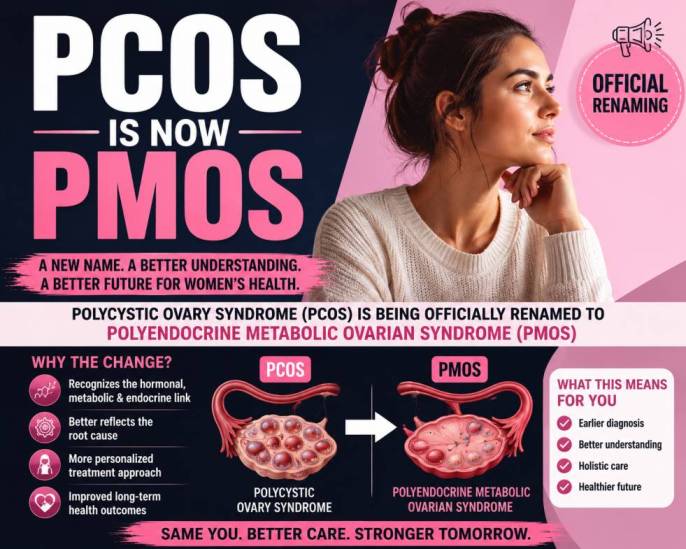
PCOS, the condition that's been plaguing women for generations and confusing doctors almost as much as it confuses patients, officially has a new name. As of May 13, 2026, it's called PMOS — Polyendocrine Metabolic Ovarian Syndrome. Published in The Lancet and announced at the European Congress of Endocrinology in Prague, this wasn't a rushed decision. This took eleven years and input from over 22,000 people worldwide to get here.
So yeah. Kind of a big deal.
The Old Name Was Honestly Just… Wrong
Let's start with why this even needed to happen.
"Polycystic Ovary Syndrome." The name makes you picture cysts. Big ones, probably. Sitting on your ovaries, causing problems. That's what most people assume — including, for a long time, a lot of doctors.
Here's the problem: those aren't actually cysts. They're immature follicles. And a huge number of women who have every single classic symptom of the condition — the weight gain, the acne, the irregular periods, the hair falling out, the fatigue — show up to an ultrasound with completely normal-looking ovaries. And then they get told they're fine.
They're not fine. They just got let down by a name.
The WHO estimates 70% of people with this condition are undiagnosed. Seventy. Percent. Think about that for a second. That's not a minor awareness gap. That's millions of women walking around being told there's nothing wrong with them, or being handed a pill and sent home, when there's actually a complex hormonal and metabolic condition running quietly in the background, doing real damage.
So What Does PMOS Actually Stand For?
The new name — Polyendocrine Metabolic Ovarian Syndrome — actually tells you what's going on in your body. Which is, you know, how medical names are supposed to work.
Polyendocrine means multiple hormones are involved. Not just the ovarian ones. We're talking about androgens, insulin, cortisol, thyroid hormones — the whole endocrine system can be pulled into this. That's why so many women with PMOS say it feels like everything is off at the same time. Because often, it genuinely is.
Metabolic is probably the most important word in the new name. For years, metabolic dysfunction — insulin resistance, blood sugar problems, cholesterol, cardiovascular risk — was treated like a side issue. A complication. Something that happened because of the condition, not part of the condition itself. That framing has now officially changed. Metabolism is central to PMOS. Not a footnote.
Ovarian still acknowledges that the ovaries are involved — irregular ovulation, reproductive health, fertility. That part doesn't go away. It just isn't the whole story anymore.
Syndrome is still in there because this isn't one single thing. It's a collection of symptoms and signs that look different on different people, which is also why it gets missed so often.
Why This Took 11 Years (And Why That's Actually Okay)
The renaming process started back in 2015, at a meeting in Sicily where, by most accounts, experts spent a fair amount of time vigorously disagreeing with each other. That's not a criticism — this stuff is genuinely complicated, and getting 22,000 people across multiple countries, languages, and medical systems to agree on anything is no small feat.
Three rounds of global surveys. Workshops. Modified Delphi methods — which is basically a structured way of building expert consensus without letting the loudest person in the room win. Over 56 academic, clinical, and patient organisations involved. And eventually, PMOS won. 87 out of 90 final expert voters supported it immediately.
The two runners-up were "endocrine metabolic ovulatory syndrome" and "ovulatory metabolic endocrine syndrome," in case you were curious. PMOS was the cleaner, more accurate option — and patients, not just doctors, helped choose it. That matters.
For Indian Women, This Is Particularly Relevant
India has a complicated relationship with PCOS. The condition is incredibly common here — estimates vary, but some studies suggest anywhere from 9% to 22% of Indian women of reproductive age may be affected, which is notably higher than many global figures. And yet, the quality of diagnosis and care has historically been patchy at best.
Part of that is access. Part of it is awareness. But a significant chunk of it is cultural — the advice women get when they do show up with symptoms. "Just lose some weight." "Get married and it'll regulate itself." "Have a baby, your hormones will sort out." These aren't fringe opinions. These are things women hear from actual doctors, and sometimes from their own families.
The PMOS rename is pushing back against that, at least within the medical system. By officially categorising this as a metabolic condition, it becomes harder for any clinician to dismiss symptoms as lifestyle issues to be fixed through willpower. Insulin resistance — which affects a disproportionately large number of South Asian women and men, due to genetic factors — is now at the centre of the diagnosis conversation.
Indian women are also at higher baseline risk for type 2 diabetes and cardiovascular disease. PMOS, if untreated or undertreated, can accelerate both. Catching it early and managing the metabolic side isn't optional — it's actually urgent.
The Symptoms Are the Same. The Understanding Isn't.
Nothing about what PMOS looks like has changed. If you've had or suspected PCOS, you already know the list. But the framing around it matters, so here it is again through the new lens:
Irregular or absent periods are still the most commonly noticed symptom. But they're not just a "period problem" — they reflect irregular ovulation, which reflects underlying hormonal disruption.
Unexplained weight gain, especially around the midsection, is a metabolic symptom first. The insulin resistance connection makes this clearer now than the old name ever did.
Acne — particularly the deep, hormonal kind that sets up camp along your jawline and doesn't respond to regular skincare — is driven by excess androgens.
Excess facial or body hair, or conversely, hair thinning on the scalp, also comes back to androgens.
Difficulty getting pregnant is obviously on the list. But framing fertility issues as the primary concern has, for a long time, meant women without immediate fertility goals got less urgency in their care. The metabolic risks don't care whether you want kids or not.
Mood problems, anxiety, and depression are now formally included as part of PMOS — not separate conditions that just happen to occur alongside it. This is significant. It means mental health support belongs in the treatment plan, full stop.
Fatigue, brain fog, and energy crashes throughout the day — often dismissed as "stress" — are frequently tied to blood sugar swings from insulin resistance.
Dark patches of skin, usually around the neck, underarms, or groin (acanthosis nigricans), are a visible sign that insulin resistance may be at play.
What Actually Changes in How This Gets Treated?
The Lancet paper didn't just announce a name change. It came with a three-year global transition roadmap covering clinical guidelines in 195 countries. Medical education. International disease classification systems. All of it is being updated.
In practical terms, that should mean a few things start to shift.
Doctors — especially GPs, not just gynaecologists — should start looking at PMOS more holistically. A proper workup should now include fasting insulin, glucose tolerance, lipid profile, and cardiovascular markers — not just an ultrasound and a hormone panel.
Treatment teams should get broader. An endocrinologist, a dietitian, a mental health professional — these aren't extras. For many women with PMOS, they're essential.
Lifestyle intervention stays at the core, and the metabolic framing actually strengthens the case for it. What you eat matters because it directly affects insulin sensitivity. How much you move matters because muscle is where glucose disposal happens. Sleep quality matters because cortisol and insulin are tightly linked. None of this is new information, but it's now backed by a clinical framing that makes it easier to justify and explain.
Here's What You Should Do Right Now
If any of this sounds familiar — whether you've had a diagnosis for years or you've been circling symptoms and getting nowhere — a few things are worth acting on.
Ask for a full metabolic workup, not just a pelvic ultrasound. Specifically ask for fasting insulin, not just fasting glucose. Standard blood sugar tests frequently miss early insulin resistance entirely. HOMA-IR, calculated from fasting insulin and glucose, gives a much clearer picture.
Rethink your diet from a blood sugar stability standpoint. Not a calorie deficit standpoint, not a "clean eating" standpoint — blood sugar stability. That means reducing refined carbs and ultra-processed foods, eating enough protein at each meal, not skipping breakfast, and leaning on foods with a lower glycaemic load. Dal, sabzi, whole grains, eggs, paneer, nuts — Indian food, done right, is actually well-suited to this.
Start lifting weights if you aren't already. Resistance training is probably the single most evidence-backed lifestyle intervention for improving insulin sensitivity. Two to three sessions a week is enough to start seeing a difference. You don't need a gym — bodyweight work at home counts.
Don't treat anxiety and low mood as separate problems. If you're managing PMOS, you're managing those too. Talk to someone. A therapist, a counsellor, whoever you have access to.
And if your current doctor dismisses your symptoms, tells you to just lose weight and come back in six months, or says your ultrasound is normal so you're fine — please know that you are allowed to seek a second opinion. You're allowed to ask for more.
The Bigger Point
There's something worth sitting with here. A condition affecting at least 1 in 8 women worldwide — 170 million people — spent decades being misnamed, misunderstood, and underprioritised. The name pointed to the wrong organ, suggested the wrong mechanism, and created a mental model that made it easy to dismiss the real complexity of what women were experiencing.
The fact that it took 22,000 people and 11 years to change four letters says something uncomfortable about how slowly medicine moves when the condition primarily affects women.
But it also says something hopeful — that it moved at all. That patients were included in the process. That the research community kept pushing.
PMOS is PCOS. Same condition, same women, same frustrations. But maybe, with a name that actually means something, the next woman who walks into a clinic feeling exhausted and confused and dismissed will have a slightly better chance of walking out with a real answer.
That's worth something.
At QuadFit, we work with women on nutrition, training, and hormonal health — not as separate boxes, but as one connected picture. If you're navigating PMOS or hormonal imbalances and want a practical plan that actually fits your life, we'd love to help. [Reach out here.]