First time I heard about this, I genuinely thought someone was pulling my leg.
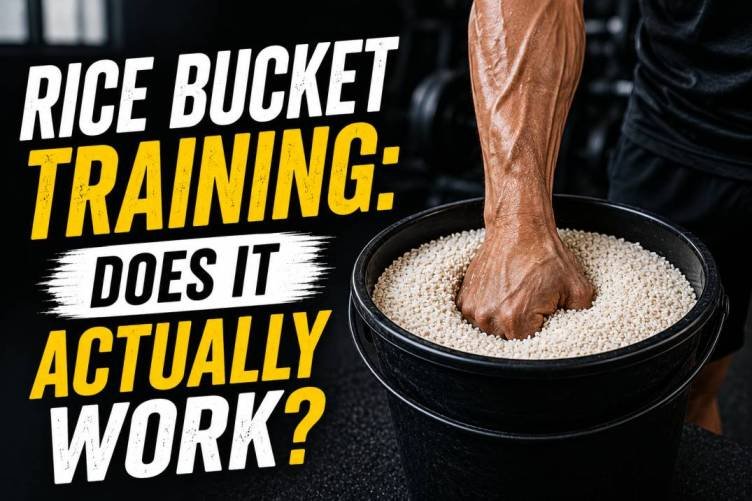
You stick your hands into a bucket of uncooked rice and move them around. That's the exercise. And apparently baseball players, climbers, martial artists, and combat sports athletes have been doing this for decades.
Sounds ridiculous. Turns out there's actually something real here — but also some limits that most content about rice bucket training conveniently skips. Let's go through both.
What Even Is Rice Bucket Training
Exactly what it sounds like.
You take a bucket — any decent-sized bucket, the kind you'd use for cleaning — fill it with uncooked rice, and perform various hand and wrist movements while your hands are submerged in the rice. The resistance comes from the rice grains pressing against your fingers, hand, and wrist from every direction as you move through it.
The resistance is low. That's not a flaw — it's the point. Rice bucket training isn't about heavy load. It's about high repetition, multi-directional resistance that standard gym equipment genuinely can't replicate.
A dumbbell curl works one plane of motion. A rice bucket works every direction simultaneously — finger extension, flexion, abduction, adduction, wrist rotation, wrist flexion and extension — all in one session.
Which Muscles Does It Actually Target
This is where it gets interesting, because most gym training completely ignores these muscles.
Finger flexors — the muscles that close your hand and grip things. These get some work from pulling exercises, but rarely in isolation and rarely through full range.
Finger extensors — the muscles that open your hand. Almost never directly trained in standard programming. Grip imbalances often come from strong flexors and weak extensors. Rice bucket training hits both.
Intrinsic hand muscles — the small muscles inside the hand itself. Responsible for fine motor control, finger independence, and overall hand stability. Basically impossible to target with conventional gym equipment.
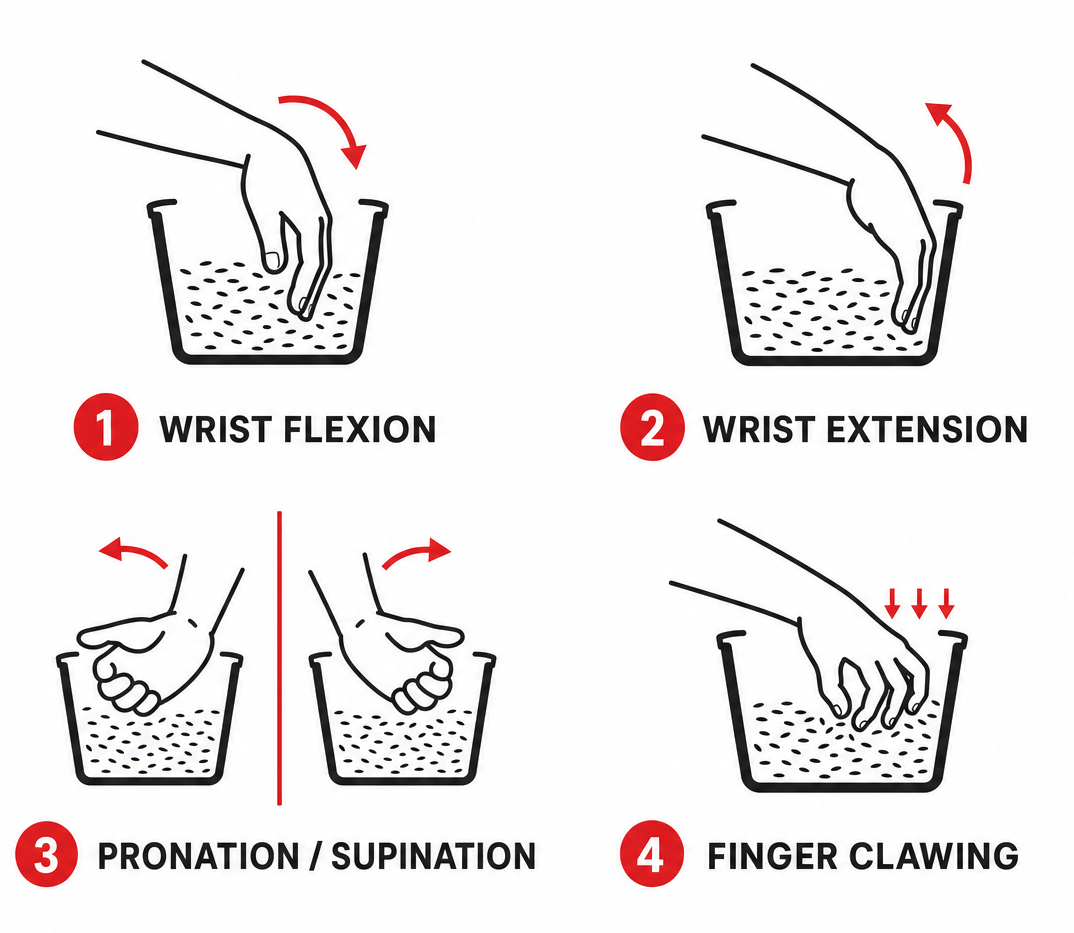
Wrist flexors and extensors — the forearm muscles controlling wrist movement. Get some work from wrist curls, but the multi-directional resistance of rice hits them differently.
Forearm pronators and supinators — muscles controlling rotation of the forearm. Again, largely ignored in standard training.
The combination of all these together is what makes rice bucket training genuinely different from just doing wrist curls or squeezing a stress ball.
Does It Actually Work — Honest Answer
Yes. With specific caveats.
For grip endurance — the ability to maintain grip force over time — rice bucket training is excellent. The high repetition, low resistance nature builds muscular endurance in the hand and forearm in a way heavy grippers don't. This is why it's popular with climbers who need to hold positions for extended periods.
For rehabilitation and injury prevention — this is probably where it shines most. Physical therapists use rice bucket exercises for hand, wrist, and forearm rehabilitation because the resistance is gentle enough to work around injuries while still stimulating the muscles and tendons. Golfer's elbow, tennis elbow, wrist strains — rice bucket work is commonly prescribed.
For grip strength in sport — baseball pitchers, cricket bowlers, martial artists, gymnasts, climbers all use it. The multi-directional resistance builds the kind of functional grip strength that translates to athletic performance in ways that purely weight-based training doesn't fully cover.
For building bigger forearms — partially. Rice bucket training will develop the forearm muscles and improve muscle endurance, but it won't replace heavy direct forearm work if your goal is visible forearm size. The resistance is simply too low for significant hypertrophy. Think of it as complementary, not a standalone solution for forearm mass.
How to Set It Up
Genuinely simple.
What you need:
Any bucket roughly 30–40cm deep. Standard uncooked rice — the cheaper the better, no need for anything special. Enough rice to submerge both hands to the wrist, roughly 5–8kg depending on bucket size.
Setup:
Fill the bucket. That's it. No other equipment needed. Total cost in India: a bucket from any hardware store, rice from any kirana. Maybe ₹300–400 all in. Lasts indefinitely — the rice doesn't wear out.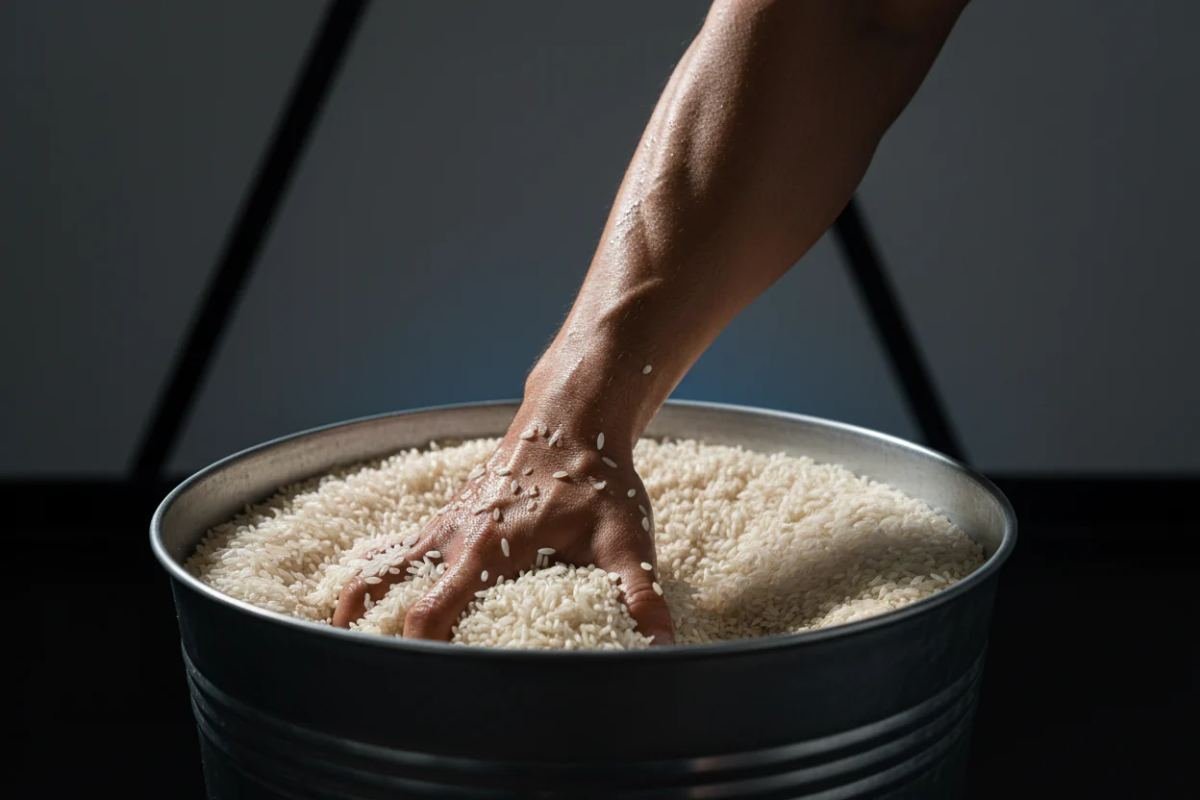
Best Rice Bucket Exercises
1. Finger Plunges
Push all five fingers into the rice repeatedly, alternating between open hand and closed fist as you push down. Start with 30 seconds, build to 60.
Targets finger flexors and extensors simultaneously. Usually the starting point for beginners because it's the most intuitive movement.
2. Finger Spreads
Submerge your hand, make a fist inside the rice, then spread all fingers as wide as possible against the resistance. Repeat slowly — the extension phase is where the work is.
This is the exercise that specifically hits the finger extensors — the most neglected muscles in most people's training. If your grip feels imbalanced or your fingers fatigue quickly, this is why.
3. Wrist Rotations
Hand submerged, rotate your wrist clockwise and counterclockwise against the resistance of the rice. 20 rotations each direction, 2–3 rounds.
Targets forearm pronators and supinators. Particularly useful for cricket bowlers, tennis players, badminton players — anyone whose sport involves wrist rotation under load.
4. Rice Scooping
Cup your hand and scoop rice from one side of the bucket to the other in a continuous motion. Sounds simple. After two minutes the forearms are talking.
Works the entire hand and wrist through a functional movement pattern. Good for building endurance.
5. Pinch Grabs
Pinch small amounts of rice between thumb and each finger individually — thumb-index, thumb-middle, thumb-ring, thumb-pinky. Work through each combination repeatedly.
Develops individual finger strength and the thumb-finger pinch strength that's critical for climbing, racquet sports, and any sport requiring precise grip control.
6. Fist Rotations
Make a fist inside the rice bucket, then rotate the entire fist in circles — small circles first, larger as the wrist warms up. 15 rotations each direction.
Combines wrist stability work with rotational strength. One of the better exercises for wrist injury prevention in this list.
How to Program It
Rice bucket training isn't a replacement for your main workout. It fits in as a warm-up, a finisher, or a separate short session on rest days.
As a warm-up: 5–8 minutes before upper body training. Gets blood into the hands, wrists, and forearms. Reduces injury risk. Improves grip readiness for pulling exercises.
As a finisher: 8–10 minutes after training when the forearms are already fatigued. Lower weight on exercises doesn't matter here — the endurance stimulus is the point.
Standalone rehab or prehab session: 15–20 minutes, 3 times per week. Useful if you're recovering from a wrist or elbow issue, or if grip is a specific weak point.
Beginner starting point:
Week 1–2: 3 exercises, 30 seconds each, 2 rounds
Week 3–4: 4 exercises, 45 seconds each, 2–3 rounds
Week 5 onwards: 6 exercises, 60 seconds each, 3 rounds
Who Should Actually Use This
Climbers — possibly the group that benefits most. Finger strength and endurance are limiting factors in climbing. Rice bucket training directly addresses both.
Cricket players — bowlers particularly. Wrist strength and forearm endurance translate directly to bowling speed and control. This is used at professional level in cricket for good reason.
Martial artists and combat sports — grip strength in grappling is obvious. Less obvious is the wrist stability work that reduces injury risk during throws and holds.
Racquet sport players — tennis, badminton, squash. The rotational wrist work in rice bucket training carries over directly to racquet control and reduces lateral epicondylitis risk.
Anyone recovering from elbow or wrist injury — the gentle, multi-directional resistance makes it suitable when heavier loading isn't yet appropriate. Check with a physio first, but rice bucket work is frequently part of formal rehabilitation programmes.
Gym-goers with grip as a weak point — if your grip fails before your back does on deadlifts and rows, this is worth adding. Won't replace straps in the short term, but builds the grip strength to need them less over time.
Limitations Worth Knowing
It won't build significant forearm mass on its own. The resistance is too low for meaningful hypertrophy. For bigger forearms visually, you still need wrist curls, reverse curls, and heavy pulling movements.
It's not a cardiovascular workout. Don't expect heart rate elevation or calorie burn.
Results take time. Grip strength and forearm endurance adaptations happen over weeks and months, not days. This isn't a quick fix — it's a long-term tool.
The Honest Verdict
Rice bucket training looks silly. Works surprisingly well for what it's designed to do.
If you want better grip endurance, healthier wrists and elbows, improved athletic hand function, or you're rehabbing a forearm or wrist issue — it's worth the ₹300 setup cost and 10 minutes three times a week.
If you want bigger forearms purely for aesthetics — add this alongside heavier direct forearm work, not instead of it.
Simple, cheap, effective in the right context. Not many training tools can say all three.
If you have an existing wrist, elbow, or hand injury, consult a physiotherapist before starting rice bucket training. Start with shorter sessions and lighter resistance if returning from injury.