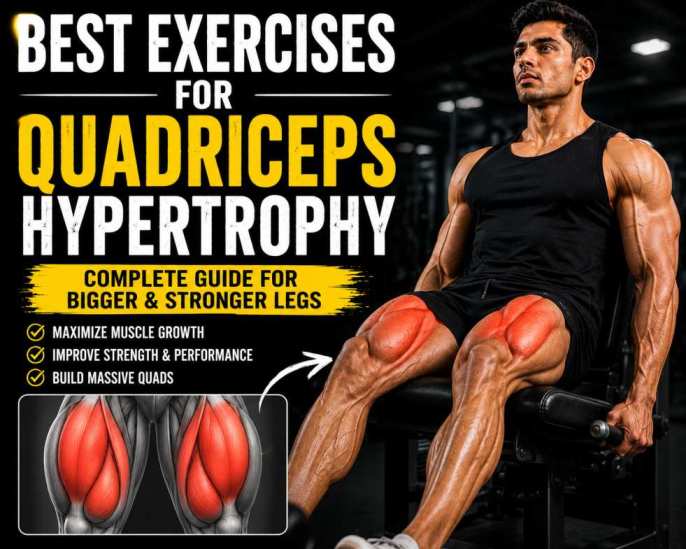
Best Exercises for Quads Hypertrophy: Complete Guide for Bigger & Stronger Legs
Leg day gets skipped more than any other session. We all know someone — maybe it's us — who has a great upper body and then... chicken legs. Not judging. Been there.
But quads specifically? They're the muscle group most people either train lazily or program completely wrong. Throw in some leg press, call it done. Then wonder why the legs aren't growing.
This guide fixes that. Exercises, a sample workout, why quad strength matters beyond just the gym — all of it. Let's go.
So What Even Are the Quads
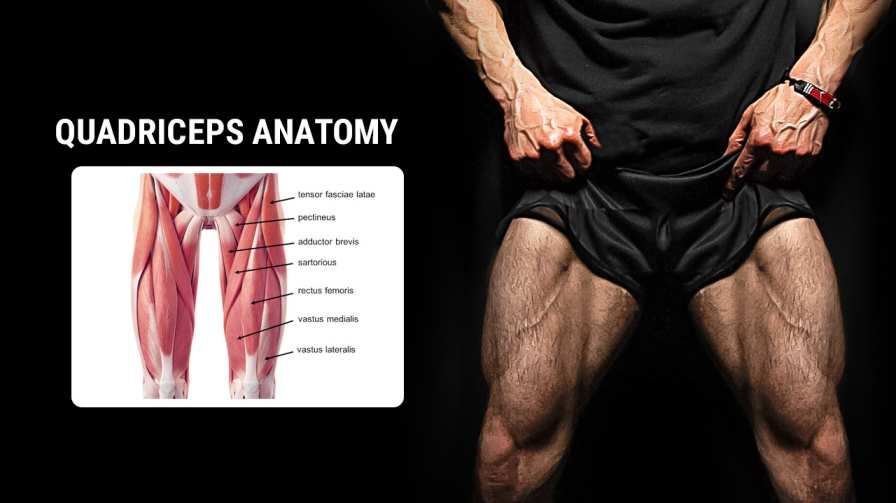
Four muscles. Front of the thigh. They all work together to extend the knee — basically straightening your leg — but each one has slightly different positioning and responds a little differently to exercise selection.
Rectus femoris sits right down the middle. Most visible one. Unusual because unlike the other three, it also crosses the hip joint — which means hip position during exercises actually affects how much it's being worked.
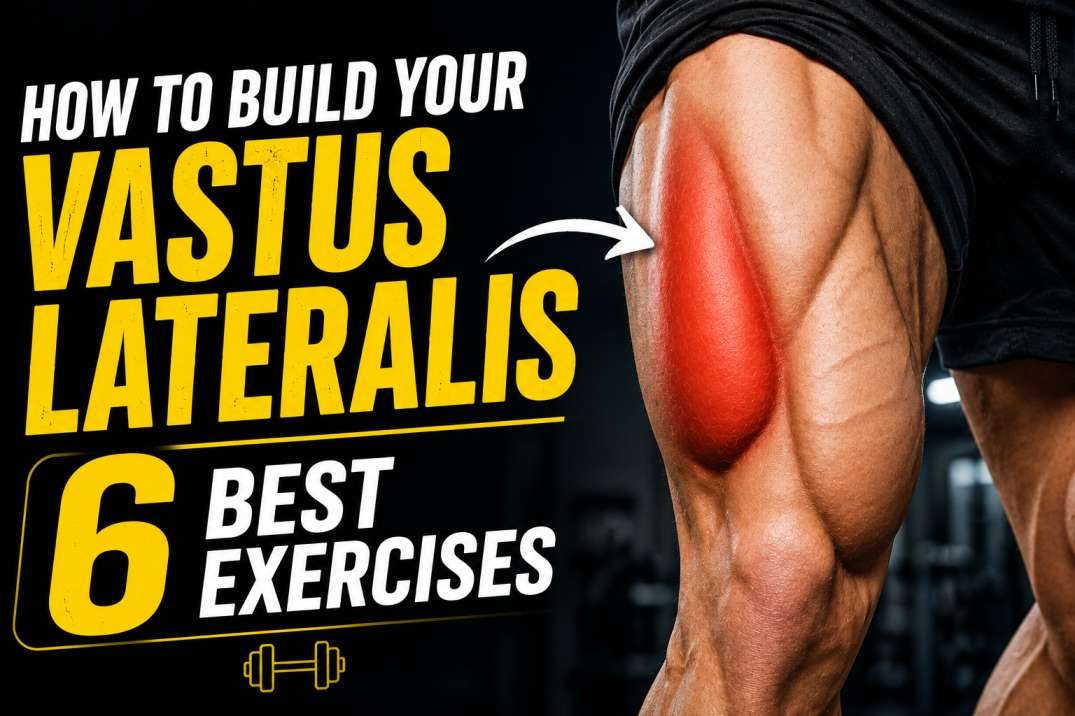
Vastus lateralis is the outer quad. This is what gives the legs that wide, sweeping look when developed. A lot of people are weak here without realising it.
Vastus medialis — the teardrop above the inner knee. Notoriously stubborn. You'll see guys in the gym for years with this muscle still underdeveloped. Takes specific attention.
Vastus intermedius sits underneath the rectus femoris, basically hidden. You can't see it directly but it contributes to overall thigh thickness.
Training all four properly means using exercises that take the knee through full range, loading the muscle at a stretch, and not just doing whatever feels comfortable.
Quads Matter Way More Than Just the Gym
This section gets skipped in most fitness content. It shouldn't.
Cycling — every downstroke of a pedal is driven primarily by quad extension. This isn't a minor contribution — it's the main power phase. Cyclists who don't specifically train their quads hit a wall on climbs and long efforts. Quad mass and strength literally translates to more watts on the bike.
Swimming — freestyle kick, butterfly kick, pushing off the wall at a turn. All quad-driven. Swimmers often have surprisingly underdeveloped quads because the resistance of water is low compared to weights. Those who supplement with gym work and specifically train quads see noticeable improvements in kick power and endurance over race distances.
Cricket — batting stance, explosive running between wickets, a fast bowler's delivery stride, fielders sprinting to cut off boundaries. All of it runs through the quads. Knee injuries in cricket are also heavily influenced by quad-to-hamstring strength ratios — weak quads increase injury risk significantly.
Football and rugby — two sports that punish weak legs. Shooting in football, accelerating, cutting direction, going into a tackle. In rugby, driving in scrums, carrying through contact, explosive lineout jumps. The quads are working constantly. Rugby forwards especially need genuine mass and strength here — not just functional strength, but actual size to absorb and produce force.
Strong quads carry over to everything. They're not a vanity muscle.
The Exercises That Actually Build Quad Mass
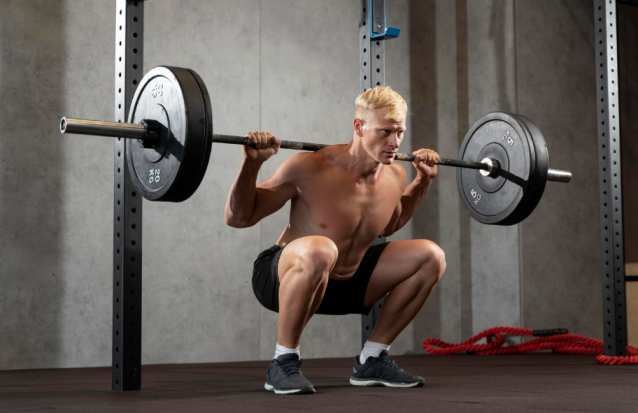
Barbell Back Squat
Still the baseline. Nothing loads the quads with as much total weight through full range.
For quad focus specifically — keep stance slightly narrower than you might for a powerlifting squat, and try to keep the torso more upright through the movement. Going to or below parallel is important — the bottom of the squat is where the quads are under the greatest stretch, and that stretched position under load is where hypertrophy signal is strongest.
Three-second controlled descent. No bouncing out of the hole.
Program it as: 4 sets of 6–8 reps. First exercise, when you're fresh.
Leg Press
Gets a bad reputation. Doesn't deserve it.
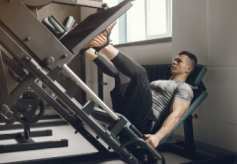
The leg press lets you load heavily without spinal compression, go very deep, and focus almost entirely on the quads. Foot placement lower on the platform emphasises quads directly. Higher foot placement shifts demand toward glutes and hamstrings — useful to know.
The error almost everyone makes: partial reps. Half the range, half the stimulus. Bring the platform down until the knees are close to the chest at the bottom. Full extension (or near it) at the top.
Program it as: 3–4 sets of 10–15 reps. Use after squats as a volume builder.
Hack Squat Machine
Underused, underrated.
The angled pad forces your torso upright and pushes your knees forward over the toes — which is exactly the mechanics that load the quads hardest. Great for the vastus lateralis specifically, which is usually the weakest link in people's quad development.
If your gym has one, it should be in your programme.
Program it as: 3 sets of 8–12 reps.
Bulgarian Split Squat
Nobody likes doing these. They're uncomfortable, the balance is awkward, and they make your front quad scream by the second set.
They're also probably the single best quad builder on this list for most people.
One foot elevated on a bench behind you, back knee lowers toward the floor. The stretch on the quad at the bottom is intense — we're talking genuine discomfort — and that deep stretch under load is one of the most potent hypertrophy triggers in training. Also trains each leg independently, which eliminates the stronger side covering for the weaker one. That matters a lot for athletic development.
For anyone playing football, rugby, cricket, or cycling — this carries over directly to single-leg explosive actions. Worth the discomfort.
Program it as: 3 sets of 8–12 reps each leg. You genuinely don't need heavy weight here.
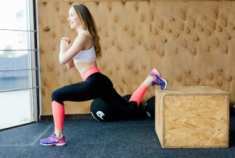
Walking Lunges
Simple. Effective. Often overlooked for serious hypertrophy work.
The forward step creates a deep quad stretch at the bottom of each rep, the range of motion is large, and doing them with dumbbells or a barbell adds real load. They also build quad endurance alongside strength — which matters for sport performance more than pure 1RM strength does.
Program it as: 3 sets of 10–12 reps each leg.
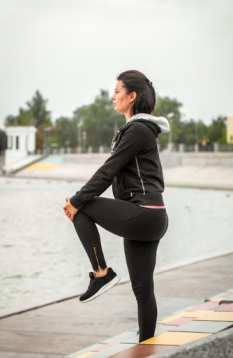
Leg Extension
Only isolation movement on this list. Earns its place.
Leg extensions target the rectus femoris and especially the vastus medialis — the teardrop — in a way compound movements simply can't fully replicate. If that inner quad above the knee won't develop for you, leg extensions done consistently and through full range will fix it.
Use them at the end of a session when the quads are already fatigued. Doesn't take much weight to get a strong response at that point.
Program it as: 3 sets of 12–15 reps. Slow, controlled. No momentum.
A Full Quad Workout to Use
| Exercise | Sets | Reps | Rest |
|---|---|---|---|
| Barbell Back Squat | 4 | 6–8 | 2–3 min |
| Hack Squat / Leg Press | 3 | 10–12 | 90 sec |
| Bulgarian Split Squat | 3 each | 8–10 | 90 sec |
| Walking Lunges | 3 each | 10–12 | 60 sec |
| Leg Extension | 3 | 12–15 | 60 sec |
Run this once or twice a week. If twice, separate the sessions by at least 3 days. Total weekly quad volume sits around 16–20 working sets — which sits within the range most research supports for hypertrophy in trained individuals.
A Few Things Worth Knowing
Knees over toes is fine. This myth refuses to die. The original study that started it was misinterpreted. In normal life — walking downstairs, getting up from the floor, squatting — the knee absolutely travels past the toes. Training through this range builds resilient knees, not damaged ones.
Frequency beats volume in a single session. Two moderate quad sessions per week outperforms one massive one. The muscle grows during recovery, not during the workout. More frequent stimulus with adequate recovery time is the better approach.
You need to progressively overload. Same weight, same reps, every week forever = no growth. Add weight when the top end of the rep range feels manageable. This doesn't mean adding 10kg weekly — small, consistent progression over months is what builds real size.
Eat enough. Obvious but real. Quads are large muscles. They need calories and protein to grow. Training hard on a severe calorie deficit limits hypertrophy significantly.
That's the Whole Picture
Quads respond well to training when you actually train them right — full range, proper exercise selection, consistent progressive overload, adequate frequency.
Whether the goal is legs that look developed, a more powerful cycling stroke, faster acceleration on a football pitch, or a stronger bowling run-up in cricket — the foundation is the same. Strong, trained quads.
Pick this workout. Run it seriously for 8–12 weeks. The legs will respond.
Warm up thoroughly before heavy quad work. If you have existing knee pain or injury history, get clearance from a physio before training heavy.