Most people who "can't run" aren't bad at running. They just started too fast.
That's genuinely it. They went out on day one, pushed hard, felt awful by minute four, and decided running isn't for them. But that experience isn't running — that's sprinting without a plan and paying for it immediately.
Real beginner running feels different. Slower than you think is necessary. More manageable than you expect. And it actually works.
Here's how to do it properly.
Before You Start — One Week of Just Walking
Not glamorous advice. Still the right advice.
If you haven't been exercising regularly, one week of 20–30 minute brisk walks before you start any running does two things. It conditions your joints — ankles, knees, hips — for repeated impact. And it builds the cardiovascular base that makes your first run sessions feel less like suffering.
Skip this if you're already active. But if you've been mostly sedentary, the week of walking is worth it.
The Only Strategy Beginners Actually Need: Walk-Run
Forget running continuously from day one. Walk-run intervals are how almost every successful beginner runner builds endurance — and it's what most proper 5K programmes are built around.
The idea is simple. You alternate between running and walking in timed intervals. The running portions are short enough that you can actually complete them without stopping. The walking portions are recovery — not failure, not cheating, just part of the method.
A basic starting structure:
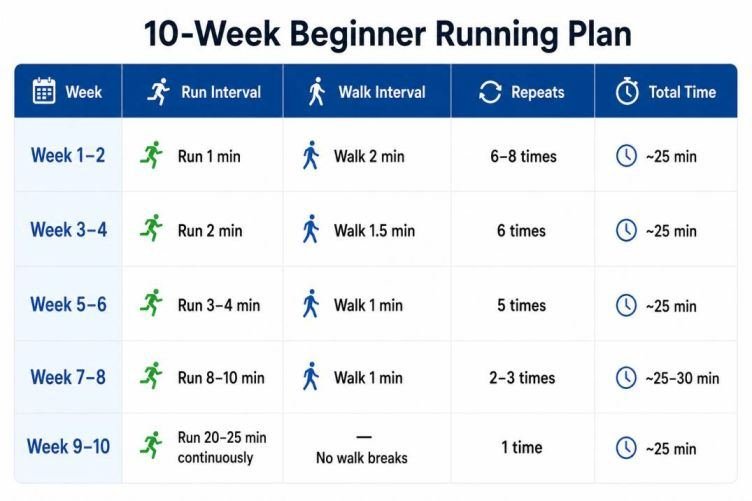
Week 1–2: Run 1 minute, walk 2 minutes. Repeat 6–8 times. Total session around 25 minutes.
Week 3–4: Run 2 minutes, walk 1.5 minutes. Repeat 6 times.
Week 5–6: Run 3–4 minutes, walk 1 minute. Repeat 5 times.
Week 7–8: Run 8–10 minutes, walk 1 minute. Repeat 2–3 times.
Week 9–10: Running 20–25 minutes continuously. Nearly there.
The progression looks slow on paper. In practice it moves faster than most people expect — because you're actually recovering between efforts instead of grinding through exhaustion every session.
Pace — This Is Where Most People Go Wrong
Your beginner running pace should feel almost embarrassingly slow.
Seriously. If someone walked past and matched your pace, that's fine. The goal in the first four to six weeks isn't speed — it's completing the time on your feet without breaking down.
A useful test: the conversation test. While running, you should be able to say a full sentence out loud without gasping. Not comfortable conversation, but possible. If you can't do that, you're running too fast. Slow down.
Most beginners run at roughly 70–80% of what feels like their maximum effort. They should be running at 50–60%. The difference feels massive on the legs and lungs. And it's what makes sessions sustainable week after week instead of dreadful every time.
Warm Up — Actually Do This
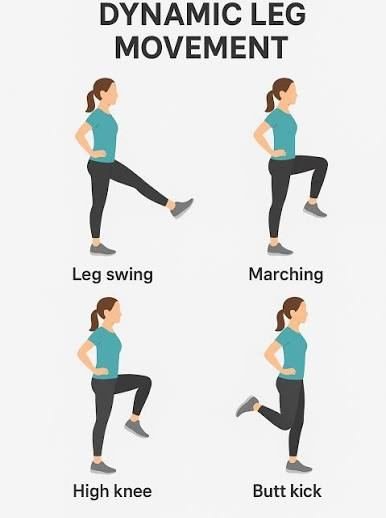
Five minutes before every run. Not static stretching — dynamic movement.
Leg swings — forward and sideways, 10 each leg. Loosens the hip joint.
Hip circles — 10 each direction. Activates hip stabilisers.
Ankle rotations — 10 each foot. Prepares the joint that absorbs impact first.
High knees walking — 20 steps. Warms up the quads and gets the heart rate moving.
Arm circles — 10 forward, 10 back. Upper body loosens too.
That's it. Five minutes. It genuinely reduces injury risk and makes the first few minutes of the run feel less like cold-starting a seized engine.
Breathing While Running
Two things most beginners don't know:
First — breathe through both your mouth and nose. Nose only isn't enough at running intensity. Mouth only tends to dry the throat. Both together, relaxed, works best.
Second — try to match your breathing rhythm to your steps. A common pattern: inhale for three steps, exhale for two. It doesn't need to be rigid, but having some rhythm stops the shallow panicked breathing that makes running feel worse than it is.
If you get a stitch — that sharp side cramp — slow to a walk, breathe deeply, press your fingers into the spot. It usually resolves in 60–90 seconds. It happens because of shallow breathing and going out too fast. Both fixable over time.
Weekly Schedule
Three runs per week is the sweet spot for beginners. More than that and the joints don't recover properly. Less than that and the adaptation happens too slowly.
Monday — Run session
Wednesday — Run session
Friday or Saturday — Run session
Other days — Walking, light stretching, rest
Rest days aren't wasted days. The cardiovascular and muscular adaptation from running actually happens during recovery, not during the run itself. Skipping rest to run more doesn't speed things up — it usually leads to shin splints, knee pain, or burnout within three weeks.
Gear — Keep It Simple
You don't need much. But one thing actually matters:
Running shoes. Not cross-trainers, not fashion sneakers — actual running shoes with cushioning designed for forward motion and impact absorption. Doesn't need to be expensive. Brands like Asics, New Balance, Nike, and Skechers all have decent beginner options at various price points in India.
Everything else — compression socks, GPS watch, specialised clothing — is optional. Good shoes are not.
One practical tip: if you're running outdoors in Indian cities in summer, go early morning or after sunset. Running in 38-degree afternoon heat as a beginner is miserable and genuinely harder on the cardiovascular system. The heat isn't an excuse — it's just a variable worth managing.
Common Mistakes That Stop Beginners Early
Starting too fast. Covered above but worth repeating — it's the most common reason people quit.
Running every day. Rest days exist for a reason. Three sessions per week, not six.
Skipping the warm-up and then wondering why the first kilometre always feels terrible. The warm-up fixes the first kilometre.
Comparing pace to other runners. Someone who's been running for two years has a different baseline. Irrelevant to your progress.
Expecting linear progress. Some weeks feel better than others. A session that feels harder than last week doesn't mean you're going backwards — it might just be sleep, stress, heat, or what you ate. Keep showing up.
Your First 5K

By week 10–12 of consistent walk-run training, most beginners can complete 5 kilometres — either running fully or with minimal walking breaks.
For your first 5K, don't aim for a time. Aim to finish. Start slower than feels necessary. Walk if you need to — there's no rule that says your first 5K has to be run continuously. Getting to the finish line matters more than how you got there.
After that first one, everything changes. The distance that felt impossible in week one is now your baseline.
That's the whole point.