
What Is HYROX? The Fitness Race Taking the World by Storm
If you've been spending any time in the fitness space lately — whether on Instagram, inside a CrossFit box, or at your local running track — chances are you've heard the word HYROX being thrown around. And for good reason. This sport has exploded from a niche European fitness event into one of the fastest-growing competitive fitness formats in the world.
But what exactly is it?
HYROX is a standardised indoor fitness race that combines running with functional workout stations. Every single athlete, regardless of age, fitness level, or background, completes the exact same course, in the same order, every time. That's what makes it unique. There are no changing formats, no mystery workouts, no surprises on race day. You know exactly what's coming — which means you can train specifically and measure your progress with precision.
In this guide, weight training and functional fitness coach Ankush Kumar (ISSA Certified), founder of The Quad Fitness Academy (TQFA), breaks down everything you need to know about HYROX — what it is, how the race works, who it's for, what the training looks like, and how complete beginners can build toward their first event.

How Does a HYROX Race Actually Work?
The format is elegantly simple, which is a big part of its appeal. Here's the race structure:
Every HYROX event consists of 8 rounds of the following pattern:
1 km run → 1 functional workout station → repeat 8 times
That means you run a total of 8 km across the race, broken up by eight different workout stations that must be completed in a fixed order. The total distance covered — including the workout stations — adds up to roughly 8–12 km of actual movement depending on your pace and transitions.
The eight workout stations, in order, are:
- 1,000m SkiErg (ski machine)
- 50m Sled Push (loaded sled, pushed down and back)
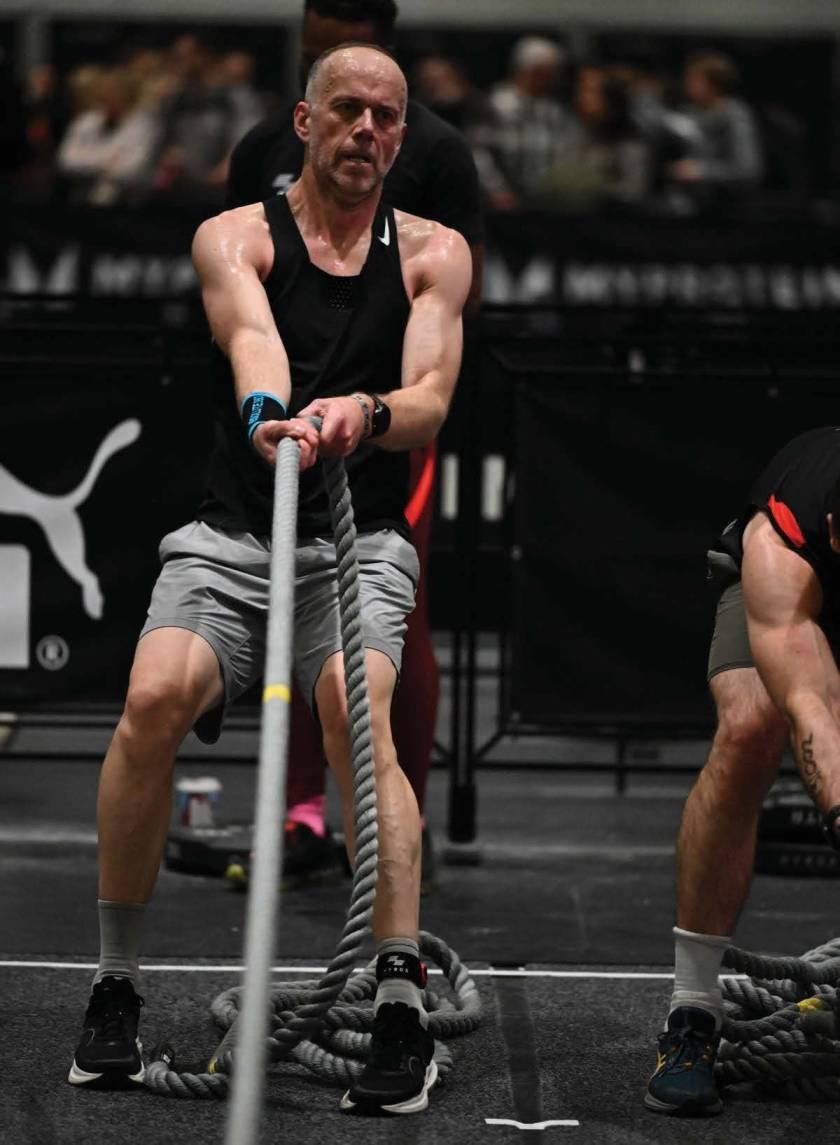
- 50m Sled Pull (loaded sled, pulled using a rope)
- 80m Burpee Broad Jumps
- 1,000m Rowing (on a Concept2 rower)
- 200m Farmers Carry (carrying kettlebells)
- 100m Sandbag Lunges (lunging with a sandbag on the shoulder)
- 100 Wall Balls (squat-and-throw to a target)
The loads at each station vary by category. Open category men typically use heavier loads — for example, a 32 kg sled push weight added to the sled's base weight, a 24 kg sandbag, and a 6 kg wall ball. Women's open category uses lighter standards, and there are pro, doubles, and relay categories as well.
You complete every station in that exact order, without skipping anything, without substitution. Finish line is after your 8th km run and 8th workout station. Your final time is everything.
 Why Is HYROX Growing So Fast?
HYROX was founded in Hamburg, Germany in 2017 by Christian Toetzke and Moritz Fürste. In its first few years it was primarily a European phenomenon. Then the combination of social media exposure, the post-pandemic fitness boom, and a genuinely accessible format sent it global.
By 2024, HYROX events were being held in over 50 cities worldwide including London, Dubai, New York, Sydney, Singapore, and Mumbai — with tens of thousands of athletes competing each season. It has attracted everyone from elite endurance athletes and CrossFit competitors to recreational runners and complete fitness beginners looking for a goal to train toward.
The reasons for its popularity are straightforward:
It's the same for everyone. Unlike obstacle course races where terrain and conditions vary, or CrossFit competitions where the workout is revealed on the day, HYROX athletes train knowing exactly what they'll face. This appeals to structured, goal-oriented people.
It's accessible without being easy. You don't need to be a games-level athlete to participate. Most events have a 2.5-hour time cap, and finishing is the goal for the majority of first-timers. But it's hard enough that training for it genuinely transforms your fitness.
It bridges running and strength. HYROX sits in the intersection between endurance and functional strength — a gap that wasn't well served by any single competitive format before. Runners find they need to build strength. Gym-goers find they need to build their engine. Both groups get humbled in interesting ways.
The community is infectious. HYROX events have the energy of a marathon combined with the camaraderie of a functional fitness gym. Athletes cheer each other on at the stations, and the finish line atmosphere is genuinely electric.
What Physical Qualities Does HYROX Demand?
This is where HYROX gets interesting from a coaching perspective. Coach Ankush Kumar describes it as a "complete athlete test" — it doesn't let you hide weaknesses the way a single-discipline sport does.
To perform well at HYROX you need:
Aerobic Base / Running Capacity Eight one-kilometre runs sounds manageable until you're doing them back-to-back with heavy functional work in between. Your ability to maintain a consistent running pace across the entire race is the single biggest determinant of your overall time. A strong aerobic engine is non-negotiable.
Muscular Endurance Not raw strength — endurance. The sled push, farmers carry, sandbag lunges, and wall balls are not one-rep-max efforts. They're sustained, moderate-load, high-rep or high-distance challenges. Your muscles need to keep working when they're already fatigued from running.
Posterior Chain Strength The SkiErg, rowing, sled pull, and deadlift-pattern movements in the carry and lunge stations all heavily load the posterior chain — glutes, hamstrings, lower back, and lats. Weakness here slows you down significantly.
Grip Strength Farmers carries, sled rope pulls, and rowing all demand grip. Many athletes underestimate this until the rope pull and their forearms are completely cooked.
Mental Resilience At some point in a HYROX race — usually around the sandbag lunges — everything hurts. Your legs are burning, your lungs are working hard, and you still have 100 metres of lunges and a final km run ahead of you. The ability to keep moving through discomfort is a real, trainable quality.
What Does HYROX Training Look Like?
There is no single "correct" HYROX training programme, but the most effective approaches share common elements. Here's how coach Ankush Kumar structures preparation for HYROX at TQFA:
Running Work (2–3 Sessions Per Week)
Your run training should include:
- Easy aerobic runs at a conversational pace, 30–50 minutes, to build your base
- Tempo intervals — for example, 5 × 1 km at your goal race pace with 90 seconds rest — to develop race-specific pacing
- Short, fast intervals (400m repeats) to improve VO2 max and top-end speed
- Transition runs — short 500m–1km runs immediately after completing a workout station, to practise running on fatigued legs
That last point is crucial. Running fresh is completely different from running after 50 metres of sled pushing. You must train the transition.
Strength and Functional Work (2–3 Sessions Per Week)
Focus on exercises that directly transfer to the race stations:
- SkiErg intervals — 4–6 × 250m or 500m with rest periods
- Sled push and pull — if you have access to a sled, practise the movement under load. If not, heavy prowler or tyre drags work
- Farmers carries — heavy, 40–80m at a time, focus on grip and posture
- Sandbag lunges — the most underrated station to practise. Load a sandbag on your shoulder and lunge for distance, not reps
- Wall balls — develop a rhythm. Unbroken sets of 20–25 are your goal before race day
- Rowing — 500m and 1,000m efforts at varying intensities
Hybrid Sessions (1–2 Per Week)
These simulate race conditions and are the backbone of true HYROX preparation. A typical session might look like:
- 1 km run → 500m row → 1 km run → 50m farmers carry → 1 km run → 20 wall balls
Start with 3–4 stations and build toward full race simulations as your fitness improves. These sessions are demanding — allow adequate recovery around them.
Mobility and Recovery
HYROX involves a lot of hip flexor, thoracic spine, and shoulder work. Regular mobility sessions, foam rolling, and adequate sleep are not optional extras — they're part of the training.
 HYROX for Beginners: Where to Start
If you're reading this with zero HYROX experience and thinking "this sounds overwhelming," here's the honest truth: most people who do their first HYROX event are not elite athletes. They're regular gym-goers and runners who decided to give it a shot.
Here's a realistic 12-week framework for a beginner:
Weeks 1–4: Build the Base Focus on running consistency (3 runs per week, keeping effort easy), and introduce the functional stations at light loads. Learn the movements — SkiErg technique, wall ball mechanics, sled positioning. Don't rush the load.
Weeks 5–8: Introduce Intensity Add tempo running and station intervals. Start combining 2–3 stations with transition runs. Increase loads gradually on carries and lunges. Begin tracking your times at each station.
Weeks 9–11: Race-Specific Training Full hybrid sessions with 5–6 stations. Practice your pacing strategy. Work on your weakest stations. Simulate the fatigue of the later race stages.
Week 12: Taper Reduce volume, maintain some intensity. Rest, prepare mentally, and trust the work you've done.
Your first HYROX goal should simply be to finish. Don't go out fast on the early runs. Pace yourself conservatively — many beginners blow up on the sled push and wall balls because they ran the first 4 km too aggressively.
HYROX vs. CrossFit: What's the Difference?
This comparison comes up constantly. Both involve functional movements, both have a strong community culture, and both attract similar athletes. But there are meaningful differences:
Standardisation: HYROX is the same workout every time. CrossFit workouts vary daily and competition formats change between events.
Running volume: HYROX has significantly more running baked into its format than typical CrossFit programming.
Olympic lifting: CrossFit includes barbell Olympic lifts — cleans, snatches, jerks. HYROX does not. The movements in HYROX are deliberately accessible to people without technical lifting backgrounds.
Competition access: HYROX is structured specifically as a mass-participation race. Anyone can sign up and compete on the same course as elite athletes. CrossFit competition is more tiered and level-gated.
The two complement each other well, and many CrossFit athletes use HYROX as a seasonal goal that develops their engine and work capacity.
Know Your Numbers Before You Train
Training hard without understanding your body's fuel requirements is working against yourself. Before you ramp up for HYROX preparation, get your nutrition baseline sorted.
- Calculate your BMR, TDEE, and daily protein target at quadfit.info/tool — HYROX training is demanding on both your aerobic system and your muscles. You need to know your maintenance calories, your training surplus or deficit, and how much protein your body needs to recover and adapt.
- Track every training session at www.dayzero.fit — log your runs, station times, loads, and hybrid workouts. Progress in HYROX prep is measurable and specific. Tracking is what shows you which stations are improving and which need more attention.
Is HYROX Right for You?
Ask yourself these questions:
- Do you enjoy running but want more variety and strength in your training?
- Do you enjoy the gym but want to build your cardiovascular fitness and have a concrete goal to work toward?
- Are you looking for a community-driven fitness event where finishing is celebrated as much as winning?
- Do you want a training format that tests your complete fitness — not just one quality?
If you answered yes to any of those, HYROX is worth exploring. It's one of the most well-rounded fitness challenges available to recreational athletes, and the training process — not just the race itself — will produce meaningful, visible improvements in your overall fitness.
As coach Ankush Kumar puts it at TQFA: "HYROX doesn't care if you're a runner who skips the gym or a lifter who avoids cardio. It finds your weakness and forces you to fix it. That's exactly why it works."
Final Thoughts
HYROX has earned its place as one of the most compelling fitness formats of the current era. It's challenging without being inaccessible, standardised without being boring, and competitive without being exclusionary. Whether you're a seasoned athlete looking for a new challenge or a beginner wanting a structured goal to work toward, HYROX offers a clear, measurable path.
Train the run. Build the engine. Respect the stations. And when race day comes — trust your preparation and go.
Interested in structured HYROX preparation or personalised functional fitness coaching? Connect with coach Ankush Kumar (ISSA Certified) at The Quad Fitness Academy (TQFA) for programming built around your goals, your timeline, and your current fitness level.