What Is a Gym Belt, and Why Do People Use One?
Walk into any serious lifting gym and you'll spot them — thick leather or nylon straps cinched around lifters' waists as they load up a barbell. Gym belts, or weightlifting belts, have been a staple of strength training for decades. But they're also one of the most misunderstood pieces of gym equipment out there.
Some lifters wear one for every single set. Others swear they weaken your core and refuse to touch one. The truth, as with most things in fitness, sits somewhere in between — and it depends heavily on how, when, and why you use it.
In this guide, weight training coach Ankush Kumar (ISSA Certified), founder of The Quad Fitness Academy (TQFA), breaks down everything you need to know about gym belts — from the science behind intra-abdominal pressure to practical advice on when to strap one on and when to leave it in your bag.
How Does a Weightlifting Belt Actually Work?
Before diving into the pros and cons, it's worth understanding the mechanism. A gym belt doesn't "hold your back together" the way many people imagine. What it actually does is give your core something to push against.
When you brace before a heavy lift, you're performing what's called the Valsalva maneuver — taking a deep breath into your belly, then contracting your core hard to create a rigid cylinder of pressure around your spine. This is called intra-abdominal pressure (IAP), and it's your body's natural stabilisation system.
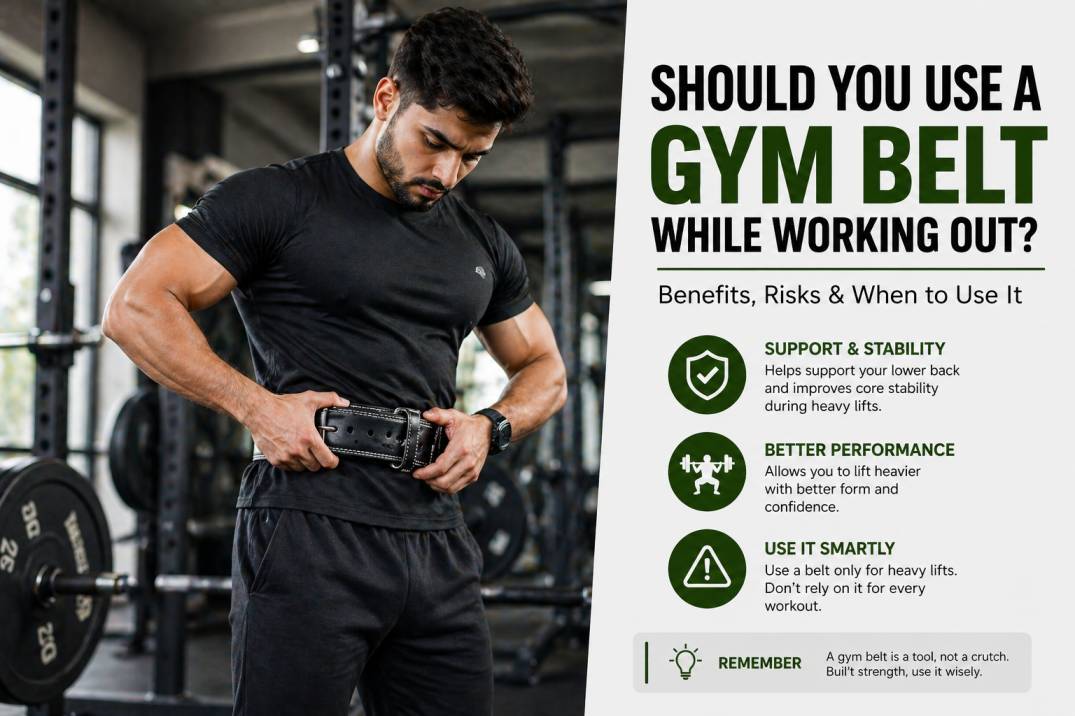
A belt works by providing a rigid surface for your abdominal wall to press outward against, amplifying that IAP significantly. More IAP means a more stable spine, which means heavier and safer lifts under load.
In short: a belt doesn't do the bracing for you. It helps you brace harder.
The Real Benefits of Using a Gym Belt
1. Increased Spinal Stability Under Heavy Load
The primary and most well-documented benefit is enhanced spinal stability. When you're squatting, deadlifting, or performing any axially loaded movement with near-maximal weight, the spine is under enormous compressive force. A belt helps distribute that load more evenly and reduces the risk of the lumbar spine buckling under pressure.
2. Improved Performance on Maximal Efforts
Research consistently shows that trained lifters can move more weight with a belt than without — particularly at loads exceeding 80–85% of one-rep max. If you're training for strength or competing in powerlifting, a belt is a legitimate performance tool.
3. Proprioceptive Feedback
This is an underrated benefit. The physical sensation of the belt around your waist gives your nervous system a reference point. Many lifters report better body awareness — they can feel whether they're bracing properly, whether they're leaning too far forward, or whether their core positioning is off. For intermediate lifters still dialling in technique, this tactile feedback is genuinely useful.
4. Reduced Fatigue During High-Volume Sessions
For competitive athletes or lifters doing multiple heavy sets across a long session, a belt can help reduce core fatigue on primary compound movements, allowing more energy to be directed into the actual lift. This doesn't mean bypassing core work — it means preserving output across a demanding programme.
5. Psychological Confidence
Many lifters report that strapping on a belt mentally signals that it's time for a serious set. That shift in mindset — the ritual of it — can improve focus and reduce hesitation on heavy attempts. This is a real, if hard to quantify, benefit.
The Risks and Downsides of Gym Belt Use
1. Core Weakness From Over-Reliance
This is the most legitimate concern, and it's one coach Ankush Kumar emphasises most with beginners at TQFA. If you're wearing a belt for every set — warm-ups, accessory work, light movements — your core never learns to stabilise on its own. Over time, this creates a dependency. Your neural patterns around unbraced stabilisation weaken, and you become functionally less stable the moment the belt comes off.
The belt should supplement a strong, well-trained core — not substitute for one.
2. Masking Poor Technique
A belt can make a technically flawed lift feel manageable when it shouldn't. If your lower back rounds on a deadlift, a belt might allow you to pull the weight anyway instead of flagging the technique breakdown. This is dangerous long-term. The belt removes one symptom — instability — without fixing the root cause: poor positioning, weak posterior chain, or inadequate mobility.
3. Elevated Blood Pressure
The Valsalva maneuver that makes belt use effective also causes a significant, temporary spike in blood pressure. For healthy trained individuals this is generally safe and transient. However, for anyone with pre-existing cardiovascular conditions or hypertension, this warrants a conversation with a medical professional before regular belt use.
4. False Security for Beginners
Giving a beginner a belt too early is like giving someone driving lessons in a car with automatic brakes. They never develop the foundational skill of managing the situation themselves. New lifters need to spend months — ideally their first year — building raw core strength, learning to brace correctly, and developing movement patterns under moderate load before a belt enters the picture.
When Should You Actually Use a Gym Belt?
According to Ankush Kumar at The Quad Fitness Academy, a belt earns its place under specific, deliberate conditions:
✅ Use a Belt When:
- You're lifting above 80–85% of your 1RM on compound movements like squats, deadlifts, Romanian deadlifts, overhead press, or heavy rows
- You're competing in powerlifting, Olympic weightlifting, or any strength sport
- You're in a peak or intensity block where maximal effort sets are programmed regularly
- You've already built a solid foundation of beltless core strength and can demonstrate proper bracing technique without one
- You're returning from a lower back injury under professional guidance, where a belt can provide temporary support during the transition back to heavy loading
❌ Skip the Belt When:
- You're warming up or working at sub-75% intensity
- You're doing accessory or isolation work (curls, lat pulldowns, cable work, machines)
- You've been training for less than 12 months and haven't yet built a proper movement foundation
- You're using it as a psychological crutch rather than a performance tool
- You can't brace properly without it — that's a signal to fix your technique first
How to Wear a Gym Belt Correctly
Most people wear their belts wrong — either too loose, positioned too low, or buckled so tight they can't breathe. Here's the correct approach:
Step 1: Position It Over the Lumbar Spine The belt should sit around your natural waist — roughly at the level of your belly button or just below. It should cover the lower back and wrap all the way around to the front. It is not a lower back brace worn low on the hips.
Step 2: Tighten to Allow a Deep Breath You should be able to take a full, 360-degree breath into your abdomen and feel the belt tighten all the way around — front, sides, and back. If it's so tight you can't breathe, loosen it. If you can slip a fist under it, tighten it.
Step 3: Brace, Then Lift Take your breath before the lift begins. Fill your belly — not your chest — with air, brace your entire core as if you're about to take a punch, and then initiate the movement. Don't breathe out mid-rep on a heavy set.
Step 4: Release Between Sets Don't keep the belt buckled between sets. It restricts blood flow when worn continuously and means your core is never actually resting. Unbuckle between sets, re-tighten when ready for the next one.
Types of Gym Belts: Which One Should You Choose?
Leather Powerlifting Belt (Single or Double Prong) The gold standard for serious strength athletes. Uniform 10cm width all the way around, stiff leather, minimal give. Takes time to break in but lasts years. Best for squatting and deadlifting at high intensities.
Tapered Leather Belt Wider at the back, narrower at the front. More comfortable for overhead pressing and Olympic lifting where full torso mobility is needed. Less rigid than a powerlifting belt.
Velcro / Nylon Belt Lighter, more flexible, easier to put on and take off. Good for general training, functional fitness, and CrossFit-style workouts. Less supportive than leather for true maximal efforts.
Lever Belt A leather belt with a lever buckle instead of a prong. A favourite among competitive powerlifters for how quickly it can be tightened and released between sets. More expensive, and the lever needs adjusting if your waist size changes.
For most recreational lifters, a quality velcro or single-prong leather belt around 10mm thick works well. For those competing or regularly handling near-maximal loads, a proper powerlifting lever or prong belt is worth the investment.
Common Myths About Gym Belts — Debunked
Myth 1: "A belt protects your back." Partially true, mostly misleading. A belt supports spinal stability under load. It does not protect you from injury caused by poor technique, excessive ego loading, or structural issues. Technique always comes first.
Myth 2: "Only powerlifters need a belt." False. Any trained individual regularly performing heavy compound lifts can benefit from belt use at appropriate intensities, regardless of whether they compete.
Myth 3: "Wearing a belt weakens your core." Only if misused. Strategic belt use on heavy sets does not weaken your core. Wearing it for every exercise across an entire training session likely does. The solution is smart programming, not avoidance.
Myth 4: "A thicker belt is always better." Not necessarily. Thickness matters, but fit and proper use matter more. A 13mm lever belt you can't position correctly is less useful than a well-fitted 10mm prong belt worn properly.
Build Your Foundation First: Core Training Before the Belt
Coach Ankush Kumar's approach at The Quad Fitness Academy is clear: earn the belt. Before any client is introduced to belt use, they spend significant time developing raw core stability through beltless training on all compound lifts, direct core work including dead bugs, pallof presses, ab wheel rollouts, and loaded carries, and consistent practice of proper bracing mechanics.
A belt on a weak, poorly braced core is noise. A belt on a strong, well-trained core is a genuine tool. Prioritise the foundation.
Track Your Training and Optimise Your Nutrition
Progress in the gym is only as good as the data you track. If you're not measuring, you're guessing.
Two tools that complement your training:
- Calculate your BMR, TDEE, and daily protein intake at quadfit.info/tool — know exactly how many calories and how much protein your body needs to recover, build muscle, and perform at your best.
- Log every workout at www.dayzero.fit — track your sets, reps, progressive overload, and belt vs. beltless performance over time. Consistency and data are what separate lifters who plateau from those who keep progressing.
Final Verdict: Should You Use a Gym Belt?
- Beginner (0–12 months): No belt. Build your core, learn to brace, master movement patterns. The belt can wait.
- Intermediate (1–3 years): Introduce a belt selectively on your heaviest sets (80%+ 1RM) for squats and deadlifts. Keep all other work beltless.
- Advanced / Competitive: Use a belt strategically as part of your equipment toolkit. It belongs on your working sets and competition attempts — not your warm-ups or accessory work.
A gym belt is not a shortcut. Used correctly, it's a legitimate tool that helps trained athletes express their strength more safely at high intensities. Used incorrectly, it becomes a crutch that papers over poor technique and an underdeveloped core.
Train smart, build your base, and when the time is right — strap in.
Frequently Asked Questions
Q1. Does a gym belt actually protect your back, or is that just a gym myth?
It's more nuanced than that. A belt doesn't shield you from injury on its own — what it does is give your core something to brace against, which increases spinal stability under heavy load. Poor technique can still get you hurt even with a belt buckled on tight.
Q2. Will wearing a belt regularly make my core weaker over time?
Only if you're using it for everything — warm-ups, light sets, accessory work. If the belt never comes off, your core never learns to stabilise on its own. Used selectively on heavy compound lifts above 80% of your max, it won't cause that problem at all.
Q3. I've been training for about six months — should I get a belt?
Honestly, not yet. The first year of training is when you build the movement foundation that makes a belt actually useful. Jump to one too early and you skip developing real bracing mechanics. Spend that time getting strong without it — the belt will make more sense later.
Q4. What's the actual difference between a leather belt and a cheap velcro one — does it matter? For general training, a good velcro or nylon belt gets the job done fine. If you're regularly pulling or squatting near your max or competing in any strength sport, a 10mm leather belt gives noticeably more rigidity and support — worth the upgrade at that point
Have questions about your training programme or want personalised guidance? The Quad Fitness Academy (TQFA) under coach Ankush Kumar (ISSA Certified) offers structured coaching for individuals at every stage of their fitness journey.