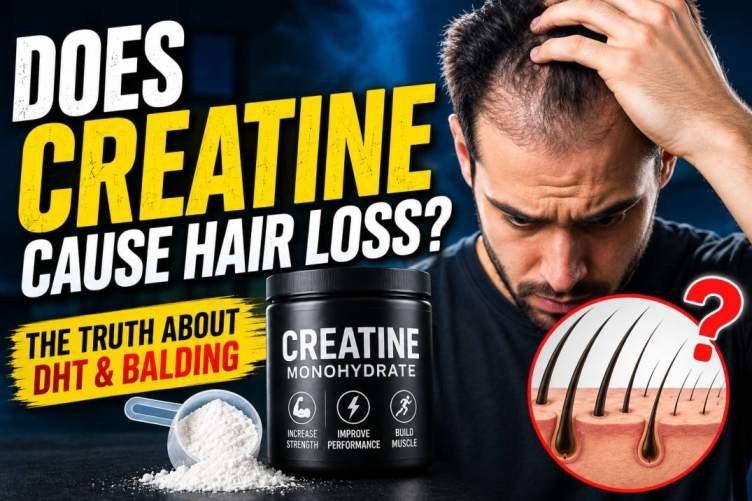
If you've spent any time in gym circles, you've probably heard this one.
"Bhai creatine mat le — baal jaayenge." Don't take creatine, you'll lose your hair.
It gets repeated constantly. In gym WhatsApp groups, in YouTube comments, by that one guy at every gym who has opinions about everyone else's supplements. And because hair loss is genuinely something most men worry about, the claim sticks.
But here's the thing — the actual evidence behind this is both more specific and more nuanced than the gym bro version suggests. There's one real study. One. And understanding what it actually found versus what people claim it found changes the picture completely.
Let's go through it properly.
What Is Creatine and What Does It Actually Do
Quick foundation before the hair stuff.
Creatine is one of the most researched supplements in existence. Your body produces it naturally — mostly in the liver and kidneys — and stores it in muscle tissue where it's used to regenerate ATP, the energy currency your cells run on during short, intense efforts.
Supplementing with creatine monohydrate increases those muscle stores. More creatine available means more ATP regenerated faster during training — which translates to better performance on high-intensity efforts, slightly faster recovery between sets, and over time, better muscle growth because you can train harder with more volume.
It's not a hormone. It's not a steroid. It doesn't directly affect testosterone. These are common misconceptions worth clearing up before getting into the hair question.
Where the Hair Loss Concern Actually Comes From
One study. Published in 2009 in the Clinical Journal of Sport Medicine.
Rugby players in South Africa were given creatine supplementation for three weeks — a loading phase followed by a maintenance phase. Researchers measured various hormones before and after.
What they found: DHT levels increased by roughly 56% [1] during the loading phase and remained about 40% higher than baseline during maintenance. The ratio of DHT to testosterone also increased.
DHT — dihydrotestosterone — is a hormone derived from testosterone via an enzyme called 5-alpha reductase. It's significantly more potent than testosterone and is the primary driver of male pattern baldness in people who are genetically predisposed to it.
So the study found creatine raises DHT. DHT is linked to hair loss. Therefore creatine causes hair loss.
That's the logic chain. And it sounds reasonable until you look at what the study actually measured and what it didn't.
What the Study Didn't Show
The 2009 study never measured hair loss. At all. (Read the original study: van der Merwe et al., Clinical Journal of Sport Medicine, 2009 — it measured hormone levels only.)
Not a single participant's hair was assessed. No hair counts, no follicle measurements, no baldness progression tracked. The study measured DHT levels in blood — that's it. The leap from "DHT went up" to "creatine causes hair loss" was made by people reading the study, not by the study itself.
Second issue: the DHT levels in the study, even after the increase, remained within normal physiological range. They went up but didn't go into abnormal territory. Whether a DHT increase within normal range actually accelerates hair loss in real people — that's a separate question the study didn't address.
Third: this study has never been replicated. Multiple subsequent studies examining creatine supplementation and hormone levels have not consistently found the same DHT elevation. Some found no significant change. Science that can't be replicated is a weak foundation for a definitive conclusion.
How Male Pattern Baldness Actually Works
This context matters enormously.
Male pattern baldness — androgenetic alopecia — is primarily genetic. It's determined by your sensitivity to DHT at the hair follicle level, which is inherited. People with follicles that are highly sensitive to DHT experience miniaturisation of those follicles over time — they shrink, produce thinner and shorter hairs, and eventually stop producing hair altogether.
The critical word is sensitivity. Two men can have identical DHT levels. One goes bald by 30. The other keeps a full head of hair at 60. The difference is genetic follicle sensitivity, not DHT levels alone.
This means if you're not genetically predisposed to male pattern baldness — if you don't have the family history, if your follicles aren't sensitive to DHT — then elevated DHT from any cause is unlikely to make you go bald. The mechanism simply isn't there.
Conversely, if you are strongly predisposed — father bald early, maternal grandfather bald, you're already noticing thinning in your 20s — then anything that elevates DHT could theoretically accelerate a process that was already happening.
So Does Creatine Cause Hair Loss — Direct Answer
Probably not for most people. Possibly a small acceleration of existing genetic predisposition in a minority of people.
That's the honest, evidence-based answer.
If you have zero family history of male pattern baldness and your hairline has been stable — the evidence does not support creatine causing hair loss in people like you. One unreplicated study showing a DHT increase within normal range is not sufficient evidence to conclude causation for the general population.
If you have strong genetic predisposition — significant family history, early thinning already starting — then creatine's potential DHT-elevating effect is at least theoretically relevant. Not proven to accelerate hair loss, but not something to completely dismiss either. A reasonable position here is personal risk tolerance rather than certainty.
What creatine definitely does not do: cause sudden dramatic hair loss, cause hair loss in people without genetic predisposition, or work through any direct hormonal mechanism on testosterone.
What Actually Causes Hair Loss — Worth Knowing
Since we're here, a few things with stronger evidence than creatine:
Genetics — the dominant factor. If the family history is there, the predisposition exists regardless of what you supplement.
Chronic stress — elevated cortisol over long periods is associated with a type of hair loss called telogen effluvium, where hair follicles prematurely enter the resting phase. This can cause significant shedding. Temporary but can be alarming.
Severe calorie restriction — crash dieting or prolonged severe deficits cause nutritional stress that accelerates hair shedding. Common in people doing aggressive cuts.
Iron and ferritin deficiency — particularly in women but relevant to men too. Low iron is one of the most commonly missed causes of hair loss.
DHT itself, through finasteride-relevant pathways — medications like finasteride work by blocking 5-alpha reductase, reducing DHT conversion. They're effective for male pattern baldness for this reason. But this is a medical treatment conversation, not a supplement conversation.
Should You Stop Taking Creatine Because of This
If your goal is muscle performance, strength, and body composition — creatine monohydrate remains one of the most evidence-supported, cost-effective supplements available. The performance benefits are real and well-documented across hundreds of studies — including the International Society of Sports Nutrition’s official position stand (Kreider et al., Journal of the International Society of Sports Nutrition, 2017).
The hair loss concern rests on one unreplicated study that didn't actually measure hair loss.
Stopping creatine because of this concern, without family history of baldness, without any current thinning — that's letting an unsupported gym myth override solid supplement science.
If you do have significant genetic predisposition and are already experiencing thinning — that's a more personal decision. The evidence doesn't prove creatine accelerates your hair loss, but it doesn't completely rule it out either. If the anxiety around it affects how consistently you'd use it, that's a legitimate factor in your personal decision.
But for the vast majority of people asking this question? The hair is fine. Take the creatine.
Practical Takeaways
One study, never replicated, showed DHT increase — not hair loss — in creatine users. DHT levels stayed within normal range even after the increase. Male pattern baldness is genetic first — DHT sensitivity at the follicle level is inherited. Without genetic predisposition, elevated DHT is unlikely to cause baldness. With strong predisposition, small theoretical risk exists but isn't proven. Creatine's performance benefits are backed by hundreds of studies. The hair loss claim is backed by one.
This article is for general information only. If you're experiencing significant or sudden hair loss, consult a dermatologist — there are multiple possible causes and proper diagnosis matters.