What is a Calorie Deficit? Complete Fat Loss Guide for Beginners (2026)
Meta Description: Confused about calorie deficits? This no-fluff beginner guide explains exactly what it is, how to calculate it, and how to actually lose fat in 2026 — without starving yourself or living in the gym.
Let's Be Honest — Most Fat Loss Advice Is Confusing on Purpose
I genuinely believe the fitness industry has a financial interest in keeping you confused. Because a confused person buys more supplements, more programs, more "detox teas," and more gym memberships. A person who truly understands how fat loss works? They don't need any of that stuff.
So let me just tell you the truth upfront: fat loss comes down to one thing. Not intermittent fasting. Not keto. Not drinking lemon water in the morning. It comes down to a calorie deficit — and once you actually get what that means, a lot of the noise just falls away.
This guide is written for people who are starting from scratch. You don't need to know anything about nutrition going in. By the time you finish reading, you'll have a clear picture of what a calorie deficit is, how to figure out yours, what to eat, how exercise fits in, and why most people fail even when they're trying hard. That last part is probably the most important.
Okay, So What Even Is a Calorie?
A calorie is just a unit of energy. That's it. When food gets broken down in your body, it releases energy — and we measure that energy in calories. The bread you eat at lunch, the oil your food was cooked in, the Coke you grabbed without thinking — all of it contains energy.
Your body uses that energy constantly. Not just when you're working out, but literally all the time. Your heart is beating right now. Your lungs are pulling in oxygen. Your brain is reading these words and processing them. Your liver is filtering your blood. All of that costs energy, measured in calories.
Now here's where it gets interesting.
Your body doesn't care whether the energy comes from the food you just ate or from the fat sitting on your stomach. To your body, fat is just stored energy — a reserve tank it can tap into when food isn't available. And that's the entire concept behind a calorie deficit.
What a Calorie Deficit Actually Means
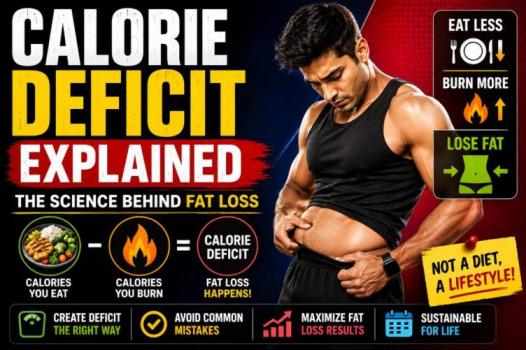
A calorie deficit simply means you're giving your body less energy from food than it needs to run itself for the day.
When that happens, your body has to get the missing energy from somewhere. And what it reaches for — at least ideally — is your stored body fat. It pulls fatty acids out of your fat cells, burns them for fuel, and over time, those fat cells shrink. That's fat loss. That's literally the whole mechanism.
There is no fat loss method on earth that doesn't work through this pathway. Whether someone is doing keto, low-carb, plant-based, or just eating smaller portions — if they're losing fat, they're in a calorie deficit. The diet style changes how they get there. But the deficit is always the engine underneath.
You can think of it like your body's bank account. Calories from food = money coming in. Calories your body burns = money going out. Spend more than you earn, and your body dips into savings. Your fat stores are the savings account.
Three possible states:
- Eat more than you burn → weight goes up (calorie surplus)
- Eat less than you burn → weight goes down (calorie deficit)
- Eat exactly what you burn → weight stays the same (maintenance)
That's the entire framework. Everything else is just detail.
Why Does the Body Store Fat in the First Place?
This is worth understanding because it helps you stop blaming yourself and start working with your biology instead of against it.
Storing fat is one of the most intelligent things your body does. For the vast majority of human history, food was unpredictable. A good hunt didn't happen every day. Crops failed. Winters were long. The human body evolved to stockpile energy during times of abundance so it could survive times of scarcity. Fat storage is a feature, not a flaw.
The problem is that we now live in a world where food is available 24 hours a day, engineered to be hyperpalatable, aggressively marketed, and often consumed mindlessly. Our biology hasn't caught up with our environment. So the same mechanism that kept your ancestors alive through winter is now quietly depositing energy into fat cells every time you eat a little more than you need.
Understanding this doesn't mean you're powerless. It means the solution isn't willpower — it's awareness and structure.
How Many Calories Does Your Body Actually Burn?
Here's a number that surprises most people: even if you never exercise a single day, your body burns a significant amount of calories just to keep you alive. This is called your Basal Metabolic Rate, or BMR.
Your BMR is the energy your body burns doing nothing — breathing, pumping blood, maintaining body temperature, keeping your organs running. For most people, this accounts for somewhere between 60 and 75 percent of all the calories they burn in a day. Your heart doesn't take a day off. Your kidneys don't clock out. That stuff runs constantly and costs energy constantly.
On top of your BMR, there are a few other things that contribute to how many calories you burn daily:
Digesting food actually burns calories. When you eat, your body has to break that food down, absorb the nutrients, and deal with the waste. This process — called the thermic effect of food — burns roughly 10% of your total daily calories. Protein costs the most to digest, which is one of the reasons it's so useful for fat loss.
Moving around burns more than people realize. This isn't about gym time — it's about all the incidental movement throughout your day. Walking to the kitchen, fidgeting in your chair, doing laundry, taking the stairs. Researchers call this NEAT (Non-Exercise Activity Thermogenesis), and it varies wildly between people. Someone who's naturally fidgety and walks around a lot can burn several hundred more calories per day than someone who barely moves outside of formal workouts.
Actual exercise. Yes, this contributes too — but probably less than you think. A decent gym session might burn 300 to 500 calories. That's meaningful, but it's nowhere near as large a number as most people assume. The idea that you can "burn off" a bad diet with exercise is, unfortunately, mostly a myth.
Figuring Out Your Own Numbers
To create a calorie deficit, you need to estimate how many calories your body burns in a total day. This number is your TDEE — Total Daily Energy Expenditure.
The most practical way to estimate it is to start with your BMR and then multiply based on how active you are.
A commonly used BMR formula (Mifflin-St Jeor):
For men: (10 × weight in kg) + (6.25 × height in cm) − (5 × age) + 5
For women: (10 × weight in kg) + (6.25 × height in cm) − (5 × age) − 161
Then multiply that number by an activity factor:
- You sit most of the day and barely exercise: multiply by 1.2
- Light exercise 1–3 times a week: multiply by 1.375
- Moderate exercise most days: multiply by 1.55
- Hard training 6–7 days a week: multiply by 1.725
The result is a rough estimate of your TDEE. Now, to lose fat, just eat below that number.
How far below?
A deficit of around 300 to 500 calories below your TDEE is the sweet spot for most people. It's enough to produce real, consistent fat loss — roughly 0.3 to 0.5 kg per week — without making you feel like you're starving or destroying your energy levels.
Some people try to go much lower, thinking faster is better. It almost never is. Severe restriction leads to muscle loss, a slower metabolism, intense hunger, and usually a rebound where you gain the weight back quickly. Going slower and keeping it sustainable is almost always the smarter play.
Protein: The Thing Most People Underestimate
If there's one thing I'd want you to take from this guide beyond the basic deficit concept, it's this: eat enough protein.
When you're eating in a calorie deficit, your body is in a state of relative deprivation. If it can't get enough energy from food, it will look for it elsewhere — and "elsewhere" includes your muscle tissue. Losing muscle is bad for a few reasons. It slows your metabolism. It makes you weaker. And it leaves you looking "soft" even when you've lost weight, rather than lean and defined.
Eating enough protein tells your body — fairly loudly — that muscle breakdown is not necessary. It provides the raw material to maintain muscle while the deficit drives fat loss. It also keeps you fuller for longer, which makes eating less feel a lot less brutal.
How much? Most research lands somewhere between 1.6 and 2.2 grams of protein per kilogram of body weight per day. If you weigh 70 kg, you're aiming for 112 to 154 grams daily. That sounds like a lot until you realize a single chicken breast has about 35 grams, and Greek yogurt at breakfast adds another 15 to 20.
Good protein sources include eggs, chicken, fish, lean beef, cottage cheese, Greek yogurt, tofu, lentils, and protein shakes if needed. You don't have to eat the same things every day — variety is fine.
Exercise: What Actually Helps (And What Doesn't)
You can lose fat without exercising. That's just true. Diet alone can create a calorie deficit, and a calorie deficit causes fat loss.
But exercise matters — just not the way most people think.
The biggest mistake beginners make is treating cardio as their primary fat loss strategy. They spend hours on the treadmill trying to "burn calories," while barely touching what they eat. The problem is that cardio burns far fewer calories than people expect, and it also tends to make you hungrier. You end up burning 400 calories on the treadmill and eating 600 extra calories later because you feel like you've earned it.
Cardio has real value — for heart health, mood, endurance, and modest calorie burn. But it should complement a calorie deficit, not replace one.
Resistance training, on the other hand, is genuinely underrated for fat loss. Lifting weights or doing bodyweight exercises doesn't burn a massive number of calories during the workout. But it does something more important: it sends a strong signal to your body to hold onto muscle while you're in a deficit. It also increases your resting metabolic rate slightly over time. People who combine resistance training with a calorie deficit consistently get better body composition results than those who only do cardio.
If you can only do one type of exercise, pick weights. If you can do both, even better.
And if formal exercise feels like a lot right now — just walk more. Seriously. Adding 30 to 45 minutes of walking to your daily routine can make a meaningful difference over weeks and months. It's low effort, low injury risk, and easier to sustain than intense workouts five days a week.
The Real Reasons People Fail at Fat Loss
I've seen so many people who were genuinely trying — eating salads, going to the gym — and still not losing weight. Here's what's usually actually going on.
They're not tracking accurately. Studies show people underestimate their food intake by 30 to 50 percent on average. That's not because they're dishonest — it's because eyeballing portions is genuinely hard. The olive oil poured into the pan, the handful of nuts grabbed from the bag, the heavy pour of salad dressing — these add up to hundreds of calories that feel invisible. Using a food scale for even two weeks is a reality check most people need.
They eat well on weekdays and overeat on weekends. A 500-calorie daily deficit for five days is 2,500 calories. But if you eat 1,000 calories over maintenance on Saturday and 500 over on Sunday, you've wiped out the entire week's deficit. One good week doesn't matter if it's followed by two bad days every single time.
They're not eating enough protein. Already covered this, but it's worth repeating because it's so commonly missed.
They expect too much too fast. If you're doing everything right, you might lose 0.5 kg per week. In a month, that's 2 kg. In three months, that's 6 kg — which is genuinely life-changing progress. But it doesn't feel dramatic week to week, so people think it's not working and give up.
Their exercise calorie estimates are way off. That smartwatch that says you burned 800 calories in a 45-minute workout? Probably off by 40 percent or more. Eating back calories based on what your tracker says is one of the most common ways people accidentally cancel out a deficit.
Realistic Expectations: What Fat Loss Actually Looks Like
The scale is going to do weird things. That's just the nature of tracking body weight daily.
Your body weight can fluctuate by 1 to 3 kg in a single day based on water retention, food volume in your gut, sodium intake, and hormonal changes. This is normal and not fat gain. What matters is the trend over weeks, not the number on any given morning.
A realistic, sustainable fat loss pace looks something like this:
- 0.3 to 0.5 kg per week for most people
- Slower if you don't have much to lose
- Potentially slightly faster if you're significantly overweight
That's not fast. But it adds up. Twelve weeks at that pace is three to six kilograms of actual fat gone — not water, not muscle, actual fat. Your clothes fit differently. Your energy changes. Your health markers improve.
Don't chase the scale week to week. Look at the average over a month.
What to Eat (Without Making Yourself Miserable)
There's no magic list of foods you must eat to lose fat. The only requirement is that your total calorie intake stays below your TDEE. Theoretically, you could lose fat eating nothing but ice cream — as long as you stayed in a calorie deficit. (Please don't do this. But the math would technically work.)
In practice, though, certain foods make it much easier to stay in a deficit without feeling terrible.
High-protein foods keep you full and protect muscle. Think eggs, chicken, fish, Greek yogurt, cottage cheese, legumes.
High-volume, low-calorie foods let you eat a lot without spending many calories. Vegetables are the best example — a massive bowl of salad with cucumbers, tomatoes, peppers, and spinach might only cost you 100–150 calories. You physically cannot be hungry eating that volume.
Fiber-rich foods slow digestion and keep hunger at bay. Oats, beans, lentils, whole fruits, and vegetables are all high in fiber.
Foods that require awareness (not avoidance): Nuts and nut butters are incredibly healthy but also incredibly easy to overeat — a small handful of almonds is around 170 calories. Same with oils, cheese, avocado, and alcohol. None of these foods are bad. They just require portion awareness because the calorie density is high.
How Long Should You Stay in a Deficit?
This depends on how much fat you want to lose, but the general principle is: don't stay in a deficit forever without breaks.
Sustained calorie restriction causes your body to adapt. Your metabolism down-regulates. Hunger hormones increase. Energy drops. Adherence becomes harder. This is why most people who diet for six or eight months straight eventually hit a wall.
A more effective pattern for most people:
- Deficit phase of 8 to 12 weeks
- Then two to four weeks eating at maintenance (not a "cheat phase" — eating at TDEE, controlled)
- Repeat if more fat loss is needed
The maintenance phase resets some of the hormonal and metabolic adaptations, restores energy, and gives you a psychological break. Most people are surprised that they don't gain fat during this phase if they're eating at an accurate TDEE.
The Mental Game Nobody Talks About
You can know everything in this article and still struggle — because fat loss is as much a mental challenge as a physical one.
Here's what I've found matters most.
Stop moralizing food. Food is not "clean" or "dirty." Eating a slice of cake doesn't make you a failure. Eating a salad doesn't make you virtuous. The moment you start attaching shame to food choices, you set up a cycle of restriction and guilt that almost always ends in overeating. A slice of cake at your friend's birthday is just a slice of cake. Log it, enjoy it, move on.
Build an environment that works for you. Willpower is genuinely limited. If your kitchen is full of hyperpalatable snacks, you will eat them eventually — not because you have no discipline, but because no one has infinite discipline. The better approach is to not buy them in the first place. Stock your fridge with food that aligns with your goals. Keep protein easily accessible.
Track what matters, not what's easy. The scale is convenient but limited. Take measurements. Take photos every four weeks. Notice how your clothes fit. These give you a fuller picture of progress than a single number.
Expect setbacks. You will have weeks where nothing goes right. You'll eat more than planned at a family dinner, skip the gym for two weeks when life gets busy, and feel like you've ruined everything. You haven't. One bad week does not undo a month of good work. The only real failure is quitting entirely.
Quick Answers to Common Questions
Do I have to count calories forever? No. Many people track for a few months, develop a strong intuition for portion sizes and food composition, and then maintain their weight without tracking. The goal is awareness, not lifelong spreadsheet management.
Will skipping breakfast help? Only if it naturally reduces your total calorie intake for the day. Breakfast timing doesn't have any special metabolic effect. If skipping breakfast means you're less hungry and eat less overall — great. If it means you're ravenous by noon and overeat — not great.
Can I drink alcohol and still lose fat? Yes, technically. Alcohol contains 7 calories per gram, which is a lot. But if you account for it in your daily calorie budget, it won't stop fat loss. The practical problem is that alcohol tends to lower inhibitions around food, disrupts sleep, and the calories add up quickly. It's not impossible — just worth being aware of.
What if the scale isn't moving? First, check your tracking. Second, check your adherence over the full week including weekends. Third, be patient — weight loss is not linear and a two-week plateau is not unusual. If it's been four weeks with no movement despite accurate tracking, consider recalculating your TDEE (your needs change as you lose weight).
Final Thoughts
None of this is complicated. It might feel like a lot to take in all at once, but the core of it is simple: eat a little less than your body burns, eat enough protein, move your body regularly, and be consistent about it for longer than feels comfortable.
Fat loss is slow. It's supposed to be. Your body is not a machine that responds to inputs instantly — it's a biological system that adapts over time. The person who loses 20 kg over a year will almost certainly keep it off longer than the person who crashes off 20 kg in two months.
You don't need a special diet. You don't need to eliminate food groups. You don't need expensive supplements or a gym membership. You need a moderate calorie deficit, enough protein, and the patience to let time do its work.
That's genuinely it.
This article is for general informational purposes only and does not constitute medical or nutritional advice. If you have underlying health conditions or are considering significant dietary changes, please speak with a qualified healthcare professional.