Walk into any gym, open any fitness app, or scroll through any health page online, and you will find protein being talked about constantly. Protein shakes, protein bars, high-protein meal plans — the word is everywhere. But here is the real question that most people never get a straight answer to: how much protein do you actually need?
Not the gym bro answer. Not the supplement company answer. The real, science-informed, practical answer that applies to your body, your goals, and your daily life.
I am Ankush Kumar — known in the fitness world as Day Zero — nutrition and fitness trainer educator and founder of Quad Fitness Academy Institute. Over the years, I have coached students ranging from complete beginners to competitive athletes, and protein intake is one of the most misunderstood topics I encounter at every single level. Some people eat far too little and wonder why they are not recovering or building muscle. Others eat excessive amounts thinking more is always better, not realizing the law of diminishing returns applies to protein just like everything else.
This guide will clear all of that up. By the end, you will know exactly how to calculate your protein needs, when to eat protein, what sources to prioritize, and how your requirements change depending on your goals.
Section 1: What Is Protein and Why Does Your Body Need It?
Before getting into numbers, it helps to understand what protein actually does inside your body — because it does a lot more than just build muscle.
Protein is made up of building blocks called amino acids. There are 20 amino acids in total, and 9 of them are classified as "essential," meaning your body cannot produce them on its own. You must obtain these from food. This is why the quality and variety of your protein sources matter as much as the quantity.
Here is what protein is responsible for in your body every single day:
Muscle repair and growth: Every time you exercise, you create microscopic damage in muscle fibers. Protein provides the amino acids required to repair that damage and build the fiber back stronger — this is how muscle growth happens.
Enzyme production: Nearly every chemical reaction in your body is catalyzed by enzymes, which are made of protein. Digestion, metabolism, detoxification — all of these processes depend on protein.
Hormone production: Many critical hormones — including insulin, growth hormone, and thyroid hormones — are either made of protein or depend on amino acids to be synthesized.
Immune function: Antibodies that defend your body against infection are proteins. A chronically low protein intake weakens your immune response over time.
Structural support: Your skin, hair, nails, bones, and connective tissue — collagen and keratin, the structural proteins — are constantly being broken down and rebuilt. This requires a steady supply of dietary protein.
Transport: Haemoglobin, the protein in red blood cells that carries oxygen throughout your body, is one of the most vital transport proteins. Without adequate protein, oxygen delivery to tissues and organs suffers.
In short, protein is not just a gym nutrient. It is a life nutrient.
Section 2: The Standard Recommendation vs. The Functional Recommendation
Most government health organizations recommend 0.8 grams of protein per kilogram of body weight per day for the average adult. On the surface, this sounds reasonable. But here is the important nuance: that number represents the minimum required to prevent deficiency in a sedentary person — not the optimal amount for performance, body composition, or long-term health.
Research published in sports nutrition and exercise science journals consistently shows that people who are physically active, older, in a calorie deficit, or trying to build muscle need significantly more than 0.8 g/kg/day.
At Quad Fitness Academy Institute, the guidelines I use with students are as follows:
Sedentary adults (little to no exercise): 0.8 to 1.0 g per kg of body weight per day This covers basic bodily functions and maintenance.
Moderately active individuals (3–4 days of light exercise per week): 1.2 to 1.5 g per kg of body weight per day This supports recovery and prevents muscle loss that can happen even with moderate activity if protein is insufficient.
Active individuals training 4–6 days per week: 1.6 to 2.0 g per kg of body weight per day This range is well-supported by current research as optimal for muscle maintenance and moderate muscle growth.
Individuals focused on muscle gain (hypertrophy training): 1.8 to 2.2 g per kg of body weight per day Higher end of the range supports maximum muscle protein synthesis when combined with proper resistance training.
Individuals in a calorie deficit (fat loss phase): 2.0 to 2.4 g per kg of body weight per day Higher protein during a deficit is critical to preserve lean muscle tissue while losing fat. This is one of the most important — and most ignored — facts in fat loss nutrition.
Older adults (50+): 1.2 to 1.6 g per kg of body weight per day Ageing reduces the anabolic response to protein, meaning older adults need more protein to achieve the same muscle-stimulating effect as younger people. This is called "anabolic resistance."
Section 3: How to Calculate Your Personal Protein Target
Let me walk you through a simple calculation so you can find your own number right now.
Step 1: Know your body weight in kilograms. If you only know it in pounds, divide by 2.2.
Step 2: Identify your goal and activity level from the ranges above.
Step 3: Multiply your body weight (kg) by the appropriate gram value.
Example 1: A 70 kg person who trains 5 days a week and wants to build muscle. Target: 70 × 2.0 = 140 grams of protein per day
Example 2: A 60 kg person who is moderately active and wants to maintain health. Target: 60 × 1.3 = 78 grams of protein per day
Example 3: A 80 kg person in a fat loss phase with intense training. Target: 80 × 2.2 = 176 grams of protein per day
These are practical, realistic targets. They are not meant to be hit perfectly every single day — they are averages to aim for consistently over time.
Section 4: Protein Timing — Does It Matter?
Yes, timing matters — but not in the obsessive, minute-by-minute way the supplement industry would like you to believe.
Here is what current evidence actually tells us about protein timing:
The "anabolic window" is real but wider than people think. You do not need to chug a protein shake within 30 seconds of finishing your last rep. The muscle protein synthesis response to exercise remains elevated for several hours post-workout. However, eating a protein-rich meal within 1 to 2 hours after training is still a smart practice.
Distribute protein across meals. One of the most practical and evidence-backed recommendations is to spread your protein intake across 3 to 5 meals throughout the day rather than eating most of it in one sitting. Each meal should ideally contain a minimum of 20 to 40 grams of protein to meaningfully stimulate muscle protein synthesis.
Pre-sleep protein is underrated. Research shows that consuming a slow-digesting protein source — such as paneer (cottage cheese), curd, or eggs — before bed supports overnight muscle repair and recovery. This is especially useful for people training in the evening.
Breakfast protein sets the metabolic tone. Starting the day with 25 to 40 grams of protein has been shown to reduce hunger hormones, improve satiety through the day, and support better body composition over time. At Quad Fitness Academy Institute, building a protein-rich breakfast is one of the first habits we establish with every student.
Section 5: Best Protein Sources — Quality Matters as Much as Quantity
Not all protein is equal. The quality of a protein source is determined by two factors: its amino acid profile (does it contain all essential amino acids?) and its digestibility (how efficiently does your body absorb and use it?).
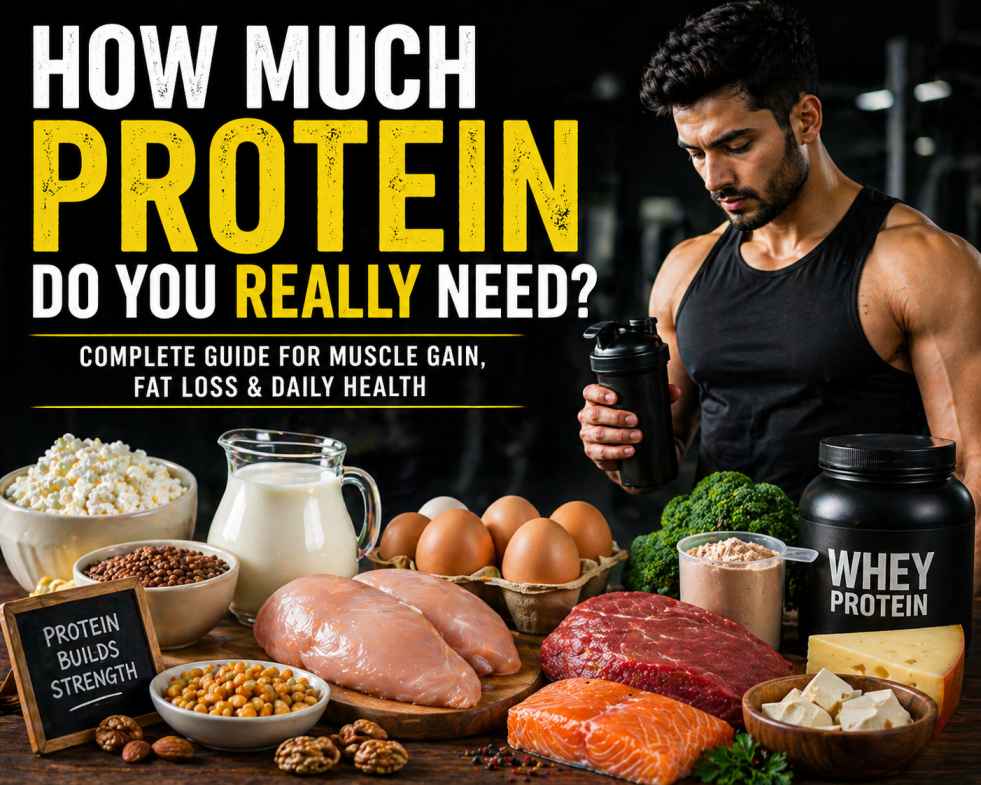
Complete protein sources contain all 9 essential amino acids:
- Eggs — one of the most bioavailable proteins available; excellent for any goal
- Chicken breast — lean, versatile, and high in protein per gram
- Fish — particularly salmon, tuna, and rohu; rich in protein and omega-3 fatty acids
- Paneer — an excellent complete protein source for vegetarians
- Curd (Greek-style or strained) — probiotic-rich with solid protein content
- Milk and dairy products
- Whey protein (from milk) — fast-digesting, ideal post-workout
Plant-based protein sources (can be combined to form complete profiles):
- Lentils (dal) — a staple in Indian nutrition and an excellent protein source
- Chickpeas and rajma (kidney beans)
- Soya chunks and tofu — among the highest plant protein sources available
- Quinoa — a rare plant food that is a complete protein on its own
- Peanuts and peanut butter — calorie-dense but protein-rich
- Seeds — hemp seeds, pumpkin seeds, and sunflower seeds
For vegetarians and vegans — a group I work with extensively at Quad Fitness Academy Institute — the key is combining plant proteins throughout the day to ensure all essential amino acids are covered. Dal and rice together, for instance, form a complete amino acid profile and have been doing so in Indian cuisine for thousands of years.
Section 6: Protein for Muscle Gain
Building muscle — hypertrophy — is a process that requires two non-negotiable inputs: a sufficient training stimulus and adequate protein availability.
Without enough protein, the body cannot rebuild muscle fibers that are broken down during resistance training. It is like laying bricks without cement. The framework exists, but the structure cannot hold.
For muscle gain specifically, here is what works:
- Aim for 1.8 to 2.2 g of protein per kg of body weight
- Train with progressive overload (increasing the challenge over time)
- Eat in a slight calorie surplus (roughly 200 to 300 calories above maintenance)
- Prioritize leucine-rich protein sources — leucine is the amino acid that most powerfully activates the muscle-building pathway (mTOR). Eggs, whey, and chicken are particularly high in leucine.
- Be consistent — muscle growth is slow and requires weeks and months of sustained effort, not days
One thing I consistently tell students at Quad Fitness Academy Institute: you cannot out-eat a poor training program, and you cannot out-train a poor diet. Both must be working together.
Section 7: Protein for Fat Loss
Here is a fact that most people entering a fat loss phase do not know: the biggest threat during a calorie deficit is not losing fat — it is losing muscle.
When you eat fewer calories than you burn, your body looks for energy from multiple sources — including your own muscle tissue. If protein intake is too low during a deficit, muscle breakdown accelerates. The result is a smaller version of yourself, but not a leaner or stronger one.
High protein intake during fat loss:
- Preserves lean muscle mass while body fat is being reduced
- Increases the thermic effect of food (protein requires more energy to digest than carbohydrates or fat — roughly 20–30% of protein's calories are burned in digestion)
- Reduces hunger and cravings by increasing satiety hormones like PYY and GLP-1 while reducing ghrelin (the hunger hormone)
- Supports better mood and energy levels during a deficit
The target during fat loss phases: 2.0 to 2.4 g per kg of body weight per day. This is higher than the muscle gain recommendation specifically because the protective effect of protein on muscle tissue becomes even more important when calories are restricted.
Section 8: Common Protein Myths — Cleared Up
Myth 1: "Too much protein damages the kidneys." In healthy individuals with no pre-existing kidney disease, higher protein intakes are safe. Research does not support the idea that normal-to-high protein consumption harms healthy kidneys. If you have kidney disease, speak to your doctor — but for most people, this concern is unfounded.
Myth 2: "Your body can only absorb 30 grams of protein per meal." This is a misleading oversimplification. Your body absorbs all the protein you eat — absorption is not capped at 30 grams. However, the rate at which amino acids are used for muscle protein synthesis is influenced by meal size and timing, which is why distributing protein across meals is still a smart strategy.
Myth 3: "Plant protein is inferior and cannot build muscle." Plant proteins can absolutely support muscle gain and recovery. The key is consuming adequate total protein from a variety of plant sources to ensure all essential amino acids are represented. Many strong, elite-level athletes follow fully plant-based diets.
Myth 4: "You need supplements to hit your protein targets." Supplements are convenient, not mandatory. Whole food sources can absolutely meet your protein needs. Whey protein, for example, is simply a processed byproduct of dairy — a convenient way to add protein, not a magic muscle-building powder.
Conclusion: Protein Is a Daily Practice, Not a One-Time Decision
Protein is not complicated when you understand the fundamentals. Your body needs it every single day, in amounts that match your goals and activity level, from quality sources that are distributed across your meals.
Whether you are trying to build muscle, lose fat, recover faster, or simply feel better every day — getting your protein right is one of the highest-return habits you can build.
As Ankush Kumar — Day Zero — founder of Quad Fitness Academy Institute, my advice is always the same: start simple. Calculate your target. Build one protein-rich meal at a time. Stay consistent for 30 days. The changes you see will teach you more than any single article ever could.
Your protein. Your performance. Your foundation.
— Ankush Kumar (Day Zero) QuadFit Coach | Nutrition & Fitness Trainer Educator Founder, Quad Fitness Academy Institute
Quick Reference: Protein Needs by Goal
| Goal | Protein Target |
|---|---|
| Sedentary / general health | 0.8 – 1.0 g/kg |
| Moderately active | 1.2 – 1.5 g/kg |
| Active (4–6 days training) | 1.6 – 2.0 g/kg |
| Muscle gain (hypertrophy) | 1.8 – 2.2 g/kg |
| Fat loss (calorie deficit) | 2.0 – 2.4 g/kg |
| Older adults (50+) | 1.2 – 1.6 g/kg |
Disclaimer: This article is for educational purposes only and does not substitute personalized medical or nutritional advice. Consult a qualified health professional for individual guidance.