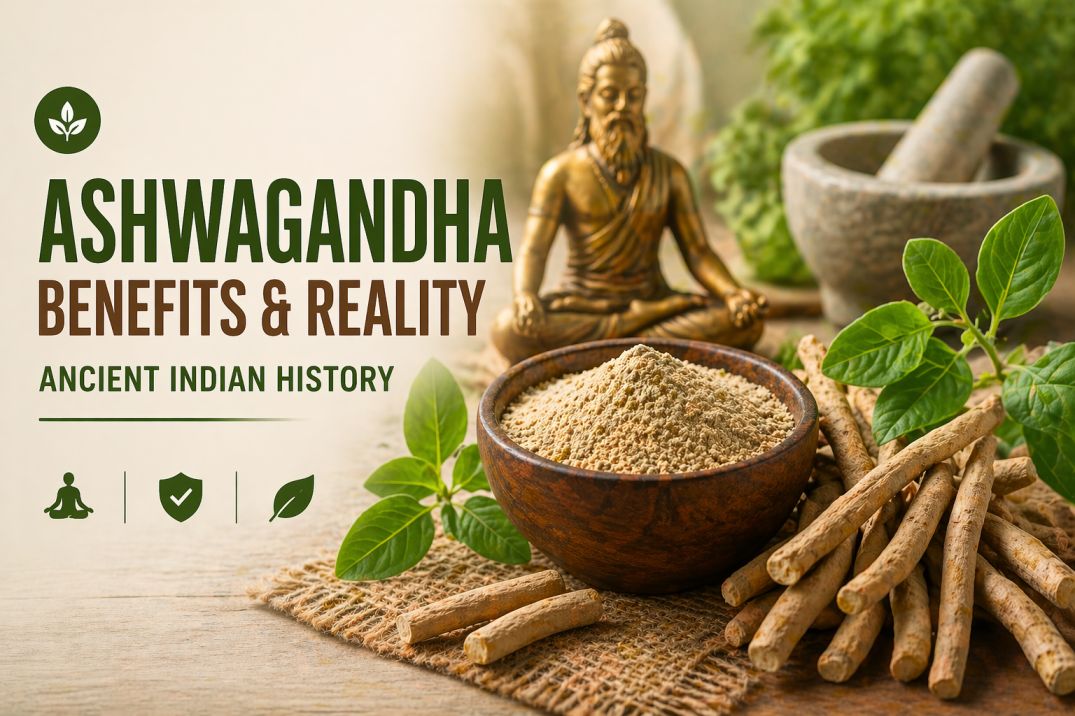
Ashwagandha Benefits & Reality: Ancient Indian History, Science & Side Effects (2026 Guide)
The Most Talked-About Herb in India Has a 3,000-Year Track Record — But Does Modern Science Agree?
Ashwagandha is everywhere right now. Instagram wellness pages swear by it. Supplement brands slap it on every third product. Your gym buddy takes it. Your grandmother probably called it "that root" her mother used to give during illness.
But here's the honest question most articles won't ask: What does ashwagandha actually do, what's overhyped, and who should be careful with it?
This guide covers all of it — the real ancient history, what peer-reviewed research in 2025–2026 actually says, practical dosage guidance, and the side effects nobody warns you about.
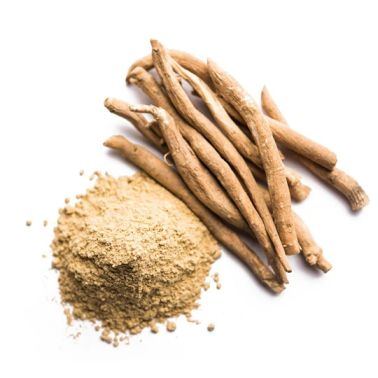
What Is Ashwagandha? (And Why Indians Have Been Using It for 3,000 Years)
Ashwagandha (Withania somnifera) is a small shrub with yellow flowers native to India, North Africa, and the Mediterranean. The name comes from Sanskrit — ashwa meaning horse and gandha meaning smell. Yes, the root smells like horse sweat. Nobody in the wellness industry mentions that part.
In Ayurveda, India's 3,000-year-old medical system, ashwagandha is classified as a Rasayana — a rejuvenating herb meant to promote longevity, physical strength, and mental clarity. It is one of the most important herbs in the entire Ayurvedic pharmacopeia, mentioned extensively in the Charaka Samhita and Sushruta Samhita, two of Ayurveda's foundational texts written between 600 BCE and 200 CE.
Traditionally it was used for:
- Building strength and stamina in children and the elderly
- Supporting fertility and sexual vitality in men
- Calming the nervous system and promoting sleep
- Recovering from illness and chronic weakness
- Supporting thyroid and adrenal function
Ancient Ayurvedic physicians would prepare ashwagandha as a churna (powder) mixed with warm milk and honey — a formulation still used in Indian households today.
What makes ashwagandha particularly interesting is that it belongs to a category of herbs called adaptogens — substances that help the body adapt to stress, whether physical, chemical, or biological. This classification didn't exist in ancient Ayurveda by name, but the concept was understood intuitively through thousands of years of observation.
The Active Compounds: Why Ashwagandha Works
Before diving into benefits, it's worth understanding what's inside the root that makes it biologically active.
The primary bioactive compounds are withanolides — a class of steroidal lactones unique to the Withania genus. Of these, withaferin A and withanolide D are the most studied and are believed to be responsible for most of the herb's therapeutic effects.
Other important compounds include:
- Alkaloids (isopelletierine, anaferine) — contribute to sedative and muscle-relaxant effects
- Saponins — anti-inflammatory and immune-modulating properties
- Iron — ashwagandha root contains meaningful amounts of iron, relevant for anemia
- Sitoindosides — shown to enhance brain acetylcholine activity
The concentration of withanolides varies widely between products. This is why clinical research and consumer supplements often produce different results — cheap powders can contain as little as 1–2% withanolides while standardized extracts used in studies typically contain 5–10%.
What Science Actually Says: Proven Benefits in 2026
Let's be precise here. There's a big difference between "there's a study on it" and "this is proven." Here's an honest breakdown.
✅ Stress and Cortisol Reduction — STRONGLY SUPPORTED
This is where the evidence is most solid. Multiple randomized controlled trials (RCTs) have shown that ashwagandha supplementation significantly reduces serum cortisol levels and perceived stress scores.
A landmark 2019 study published in Medicine gave 240 mg of ashwagandha extract daily to stressed adults. After 60 days, the ashwagandha group showed a 23% reduction in cortisol compared to placebo — a clinically meaningful drop.
A 2021 double-blind RCT using KSM-66 extract (the most studied commercial form) confirmed significant reductions in PSS (Perceived Stress Scale) scores within 8 weeks.
Why this matters for Indians: India consistently ranks among the most stressed populations globally. Urban Indians dealing with long commutes, high-pressure jobs, and poor sleep are precisely the demographic that the cortisol-lowering effect helps most.
✅ Sleep Quality — WELL SUPPORTED
The species name somnifera literally means "sleep-inducing" in Latin — ancient botanists noticed this too.
A 2020 study in PLOS ONE using 600 mg of ashwagandha root extract daily found significant improvements in sleep onset, sleep quality, and morning alertness in people with insomnia. The compound triethylene glycol found in ashwagandha leaves appears particularly responsible for sleep induction.
This is one of the most underrated benefits. Better sleep means lower cortisol, better muscle recovery, improved mood, and healthier metabolism. For anyone struggling with poor sleep in India's noisy, light-polluted cities, this is significant.
✅ Testosterone and Male Fertility — SUPPORTED (With Caveats)
Several studies have found ashwagandha supplementation improves testosterone levels, sperm count, and sperm motility in men — particularly those under chronic stress or with fertility issues.
A 2015 study in Fertility and Sterility found that men taking ashwagandha for 90 days showed a 17% increase in testosterone and significant improvements in sperm quality compared to placebo.
The honest caveat: Most studies are in men with existing fertility issues or high stress. If your testosterone is already normal and you're not under significant stress, the effect may be minimal. Ashwagandha is not a steroid replacement.
✅ Strength and Exercise Performance — MODERATELY SUPPORTED
A well-cited 2015 study in the Journal of the International Society of Sports Nutrition found that men taking 300 mg KSM-66 twice daily for 8 weeks showed significantly greater increases in muscle strength (bench press and leg extension), muscle recovery, and testosterone compared to placebo.
Another 2021 study showed improved VO2 max (cardiovascular endurance) in both athletic and non-athletic adults taking ashwagandha.
For Indian gym-goers and athletes, this is promising. It won't replace training, nutrition, and sleep — but as a supportive supplement, it has real evidence.
✅ Thyroid Support — EMERGING EVIDENCE
A 2018 study found that ashwagandha supplementation for 8 weeks significantly improved TSH, T3, and T4 levels in patients with subclinical hypothyroidism. This is a real and underappreciated effect.
Important warning: Because it can stimulate thyroid activity, people with hyperthyroidism or those on thyroid medication must consult a doctor before using ashwagandha. This is not optional advice.
⚠️ Anxiety Reduction — SUPPORTED BUT OVERSTATED
Ashwagandha does reduce anxiety — but it's not a treatment for anxiety disorders. Studies consistently show improvements in GAD-7 (Generalized Anxiety Disorder) scores in people with mild to moderate anxiety, but clinical anxiety disorders require proper diagnosis and treatment, not supplements.
Think of it as taking the edge off chronic background stress — not replacing therapy or medication.
❌ Claims With Weak or No Evidence
Let's be honest about what's overhyped:
Memory and cognitive enhancement in healthy people — studies are mostly in elderly populations with mild cognitive impairment. Evidence in healthy young adults is weak.
Cancer-fighting properties — in vitro (test tube) studies show withaferin A can kill cancer cells. This does not mean ashwagandha treats cancer in humans. Not even close.
Blood sugar reduction — preliminary animal studies exist. Human evidence is currently insufficient to make this claim.
Immune system boost — vague, poorly defined, and not proven in well-designed human trials.
Ashwagandha Dosage: What Research Actually Uses
The problem with most ashwagandha products in India is they don't specify the form or withanolide concentration. Here's what the actual studies used:
| Purpose | Dose Used in Studies | Duration |
|---|---|---|
| Stress & cortisol | 240–600 mg/day | 60–90 days |
| Sleep | 300–600 mg/day | 8–10 weeks |
| Male fertility | 675 mg/day (in 3 doses) | 90 days |
| Strength & muscle | 600 mg/day | 8 weeks |
| Thyroid support | 600 mg/day | 8 weeks |
Forms available in India:
- KSM-66 — root extract, 5% withanolides, most studied commercial form
- Sensoril — root + leaf extract, 10% withanolides, higher potency
- Raw churna (powder) — traditional, widely available, low standardization
- KSM-66 capsules — most consistent dosing, widely available on Amazon India and pharmacies
When to take it: Most studies give it with meals. For sleep benefits, evening dosing makes more sense. For stress and performance, morning or split dosing works well.
Side Effects: The Honest List Nobody Talks About
Ashwagandha is generally safe for most adults at recommended doses — but "natural" doesn't mean risk-free. Here are the real concerns:
Gastrointestinal issues: The most common side effect. Nausea, loose stools, and stomach upset, particularly when taken on an empty stomach. Always take with food.
Drowsiness: It has mild sedative properties. Taking high doses during the day can cause sluggishness, particularly in people sensitive to sedative herbs.
Liver toxicity (rare but documented): This is the serious one. Several case reports published between 2019–2023 have documented drug-induced liver injury (DILI) in people taking ashwagandha supplements, typically at high doses or over long periods. Most cases resolved after stopping the supplement, but a few required medical intervention. The withanolide withaferin A appears to be hepatotoxic at high concentrations.
Do not take ashwagandha if you:
- Are pregnant (can cause uterine contractions and miscarriage — well documented)
- Are breastfeeding
- Have hyperthyroidism or Graves' disease
- Take immunosuppressant medications
- Have autoimmune conditions (lupus, rheumatoid arthritis, MS) — it stimulates the immune system
- Are scheduled for surgery (can interact with anesthesia)
- Have active liver disease
Recommended cycle: 8–12 weeks on, 4 weeks off. This is not officially mandated but is a sensible precaution given the liver injury data and the fact that most studies run for 8–12 weeks — we simply don't have strong safety data beyond that window.
How Indians Are Taking Ashwagandha: Traditional vs Modern
Traditional Ayurvedic preparation: 3–6 grams of ashwagandha churna mixed in warm full-fat milk with a teaspoon of honey or jaggery before bed. This is still used widely in rural India and by Ayurvedic practitioners.
Modern supplement form: 300–600 mg standardized extract capsule (KSM-66 or Sensoril) once or twice daily with meals. More predictable dosing, less culturally satisfying.
Both work. The key difference is standardization — the traditional powder is less consistent in withanolide content but comes with the natural matrix of the whole root. Capsules offer precision but may lack some cofactors present in the whole plant.
For general use, either works. For therapeutic purposes — fertility, thyroid, anxiety — standardized extracts give more reliable results.
Buying Ashwagandha in India: What to Look For
India's supplement market is largely unregulated and full of underdosed, adulterated products. Here's how to buy smart:
- Look for KSM-66 or Sensoril on the label — these are patented, tested extracts
- Check for withanolide percentage (minimum 5% for KSM-66)
- Avoid products that only say "ashwagandha extract" without specifying the form
- Buy from brands with FSSAI certification
- Popular reliable brands in India: Himalaya, Carbamide Forte, NutriJa, and international brands like Jarrow and NOW Foods available on Amazon India
Bottom Line: Should You Take Ashwagandha?
Yes, consider it if you:
- Experience chronic stress and elevated anxiety
- Have poor sleep quality
- Are a man dealing with fertility concerns or low testosterone
- Train regularly and want better recovery
- Have subclinical hypothyroidism (with doctor's approval)
Be cautious or avoid if you:
- Are pregnant or trying to conceive (women)
- Have autoimmune or thyroid conditions
- Are on prescription medications (always check interactions)
- Have any liver condition
Ashwagandha is one of the most evidence-backed traditional herbs in the world. It has earned its reputation — but it's not magic, it's not for everyone, and it needs to be used with the same respect you'd give any bioactive substance.
Three thousand years of Ayurvedic use and a growing body of modern clinical research point in the same direction: ashwagandha works, within specific contexts, at proper doses, for the right person.
That's a more honest conclusion than most supplement brands will give you.
Always consult a qualified healthcare provider before starting any new supplement, especially if you have pre-existing conditions or take medications